What Did Paul Know About Jesus?
Paul never writes a life of Jesus, but his undisputed letters still place Jesus in a Jewish family, under the law, descended from David, teaching, eating a final meal, being crucified and leaving a brother Paul personally met.
3 sections4 citations1 figure
Paul does not write a biography of Jesus. That observation is true, old and worth explaining. It becomes an argument for mythicism only after a second premise is smuggled in: if Paul believed Jesus had recently lived, his letters ought to contain something like a compressed Gospel. They do not. Therefore Paul's Jesus must have been celestial.
The premise mistakes correspondence for biography. Paul's surviving letters answer disputes in communities he had already taught. They discuss circumcision, factionalism, sex, food offered to idols, money, worship and resurrection. Paul does not recount his own childhood, conversion or first meeting with Peter either. We reconstruct those matters from remarks made because an argument happened to require them.
Read the letters on those terms and the silence is not empty.
The incidental dossier
Across the seven letters accepted as authentic by the broad critical consensus, Paul says that Jesus:
- was "born of a woman" and "born under the law" (Galatians 4:4);[1]
- was descended from David "according to the flesh" (Romans 1:3);[1]
- had brothers, including James, whom Paul met in Jerusalem (Galatians 1:18–19; 1 Corinthians 9:5);[1][4]
- belonged to Israel and served "the circumcised" (Romans 9:4–5; 15:8);[1]
- gave teachings about divorce and support for missionaries (1 Corinthians 7:10–11; 9:14);[1]
- held a final meal "on the night when he was handed over" (1 Corinthians 11:23–25);[1]
- was crucified and buried (1 Corinthians 2:8; 15:3–4);[1]
- appeared after death to Cephas, the Twelve, James and others whom Paul treats as identifiable people (1 Corinthians 15:5–8).[1]
Not every item carries equal weight. Romans 1:3 and 1 Corinthians 15:3–5 probably contain inherited formulae. The tradition in 1 Corinthians 11 is disputed in detail. "The rulers of this age" in 1 Corinthians 2:8 may include cosmic powers as well as human rulers. None of that makes the dossier disappear. The cumulative picture is of a recently deceased Jewish man with relatives, teachings, followers and a remembered death.
Revelation is not Paul's only source
Galatians 1:11–12 says Paul did not receive his gospel "from a human source" but through a revelation of Jesus Christ. Here gospel means the message Paul defended, especially his gentile mission without circumcision. It does not mean every fact he knew about Jesus.
The same letter says Paul visited Cephas for fifteen days and met James (Galatians 1:18–19). Elsewhere Paul distinguishes a command "of the Lord" from his own judgment (1 Corinthians 7:10–12), passes on a supper tradition he says he "received" (11:23), and delivers a resurrection formula using the standard language of receiving and handing on tradition (15:3).[1] Revelation, contact and tradition all appear in the same small corpus. Turning one sentence about the source of Paul's commission into a prohibition on every human source requires Paul to contradict himself within pages.
What the silence can establish
Paul shows little interest in Jesus's miracles, parables, birthplace or childhood. That matters. It warns against using Paul to reconstruct a detailed Gospel life and tells us that his preaching centred on death, resurrection and gentile inclusion. It may also show how little narrative tradition had become fixed by the 50s.
But "Paul does not tell stories about Jesus" and "Paul knew no earthly Jesus" are different claims. The first is a fair description of the letters. The second has to explain why a celestial being is born from a woman, belongs to Israel, has travelling brothers and leaves one of them available for Paul to meet. The ordinary reading does not need a separate metaphor for every ordinary human detail.
Sources and further reading
- Galatians 1:11–24; 4:4; 1 Corinthians 7:10–12; 9:5, 14; 11:23–25; 15:3–8; Romans 1:3; 9:4–5; 15:8. ↩ ↩2 ↩3 ↩4 ↩5 ↩6 ↩7 ↩8 ↩9
- James D. G. Dunn, Jesus Remembered (Eerdmans, 2003), especially the discussion of Pauline evidence.
- Maurice Casey, Jesus: Evidence and Argument or Mythicist Myths? (Bloomsbury T&T Clark, 2014).
- Chrissy M. Hansen, "Familial Brother(s) of the Lord?", Expository Times 136/11 (2025), 483–493. ↩
Figures
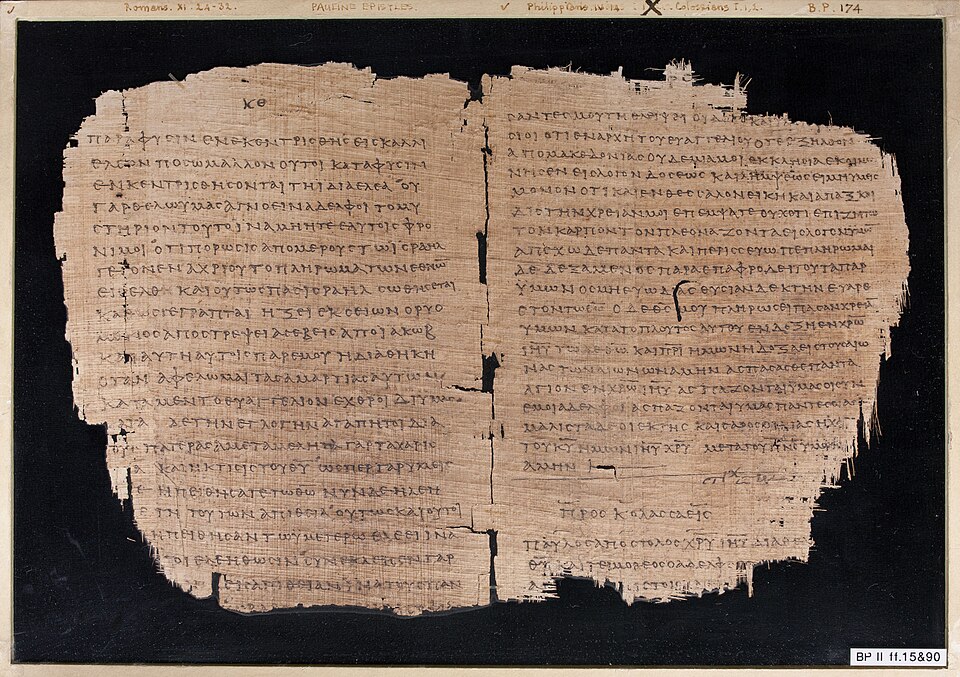
- Fig. 1 · Papyrus 46 (Chester Beatty, c. 200 CE), the oldest surviving collection of Paul’s letters: a bifolio spanning Romans, Philippians and Colossians. Wikimedia Commons