Shroud of Turin
The case for a historical Jesus does not depend on the Shroud of Turin.
Responding to mythicism.web.app/shroud-of-turin
Claim headings and boxes summarise the source; consult the linked page for its original wording.
The response
The case for a historical Jesus does not depend on the Shroud of Turin.
Disproving a relic claim would establish that the object is not what its advocates say. It would not show that Jesus never existed.
This site accepts the medieval dating of the Shroud. The evidence for that conclusion is examined below. The point for the wider debate is straightforward: no argument for Jesus’s existence presented here depends on identifying this cloth as his burial shroud.
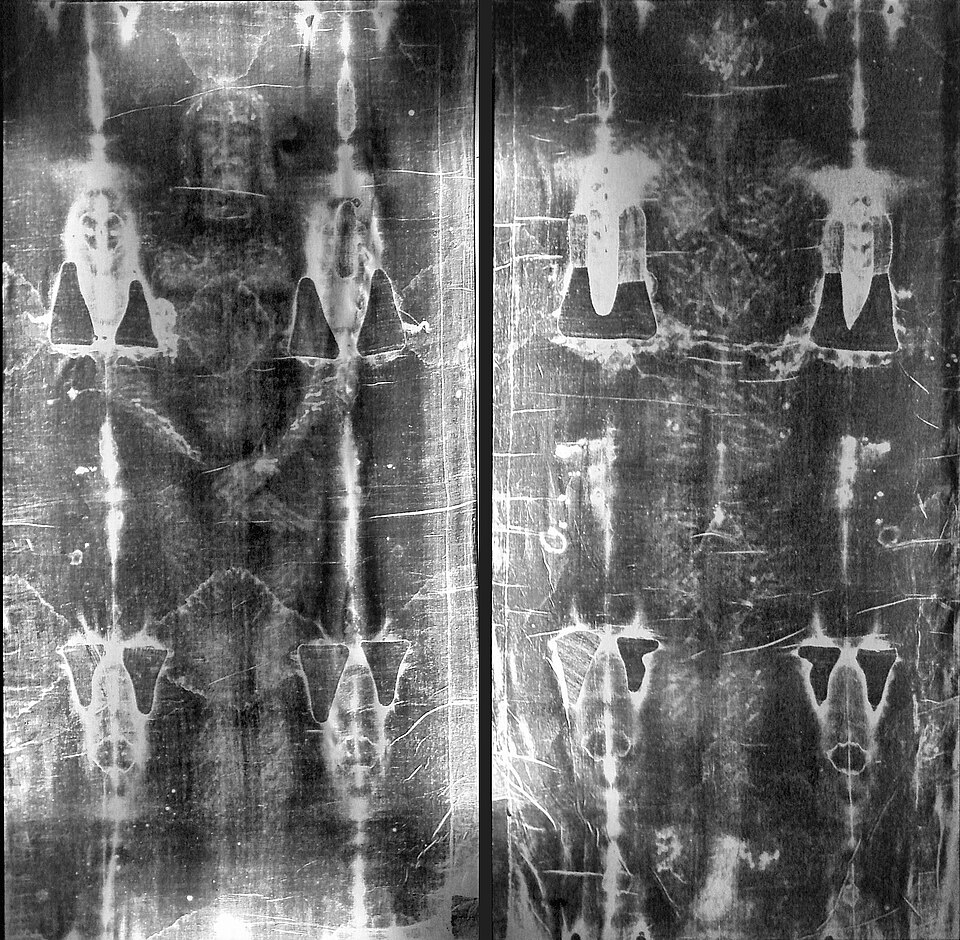
"The shroud is a medieval forgery"
Source claim (summary): Radiocarbon dating by three independent labs in 1988 placed it at 1260–1390 CE. Bishop d'Arcis reported that an artist had confessed. The 3:1 herringbone weave needs looms that didn't exist until the 13th century. Joe Nickell replicated the image with bas-relief and pigment in 1978; a 2025 study argues the image came from a sculpture. The "repaired sample" objection is ridiculous. The WAXS 2022 study assumes a 2,000-year age and invents storage conditions to fit.
Agreed on the verdict and on nearly every particular:
- The radiocarbon result is decisive and has survived its challenges. Oxford, Zurich and Arizona independently returned 1260–1390 CE (Damon et al., Nature, 1989). The "invisible reweave" rescue hypothesis was tested against the labs' raw data and found without support – Freer-Waters & Jull found no anomalous fibres in the retained Arizona sample, and the samples were cut under supervision from the main cloth. The page's sharper phrasing (the Church supplied the samples) makes the conspiracy version self-defeating, which is fair.
- The documentary record agrees with the physics. The shroud surfaces at Lirey c. 1355 with no prior history; Bishop d'Arcis's 1389 memorandum to Clement VII reports his predecessor's inquest and an artist's confession; the Avignon pope then permitted exhibition only as a "figure or representation." A relic whose own fourteenth-century ecclesiastical paperwork calls it a painting, dated by three labs to precisely that century, is as closed as historical cases get.
- The image mechanics point the same way. The weave, the elongated proportions the page catalogues (standard Gothic figure conventions), the hair hanging as on an upright figure rather than a supine one, the bas-relief replications from Nickell onward, and the 2025 3D-modelling study finding the imprint geometry matches a shallow sculpture rather than a human body – convergent with the dating rather than fighting it.
- The WAXS critique is correct and worth keeping. The 2022 wide-angle X-ray paper reasons in a circle: it assumes a two-millennium age and first-century Judaean storage conditions, finds the cellulose less degraded than that assumption predicts, and attributes the gap to fortunate European storage – rather than to the fourteenth-century age that would dissolve the anomaly. The page's dissection of this is genuinely well done. (One nuance for the record: 2025 reporting of a "newly discovered medieval document" mostly reflects renewed attention to Nicole Oresme's remark and the d'Arcis file – the documentary case was already sufficient.)
The page has since added evidence on the same side of the ledger. An April 2026 re-examination of the 1988 sampling reports no evidence that the tested material came from a repair and "no signs of repair." It also notes that the Shroud's greater uniformity and higher warp and weft density, ordinarily read as marks of textile quality, point to a later date than the control samples. That is one more nail in the reweave hypothesis, from their side of the table, and it is welcome.
Where is the disagreement, then? Only in the implied target. The shroud's exposure is a defeat for a strand of relic apologetics that critical scholarship never joined: no academic historical-Jesus case – not Sanders, not Meier, not Ehrman, not even conservative scholarship's serious wing – has ever cited the shroud as evidence, and Christian scientists and historians were among those who accepted 1988 immediately. This site said it on the home page from day one and repeats it here: the shroud is a medieval artefact, and its fakeness bears on the existence of Jesus exactly as much as fake Shakespeare portraits bear on the existence of Shakespeare. The page wins its argument; the argument was never about our question. (The same goes for its closing list – the Cadouin cloth turned out to be eleventh-century Islamic weaving with Kufic inscription, the Oviedo sudarium's paperwork comes from a famous forger's scriptorium, the Mandylion is legend via Eusebius, duly distrusted. Multiplicity was always the tell; see Relics.)
Full bibliography
- P. E. Damon et al., Nature 337 (1989), 611–615.
- R. A. Freer-Waters & A. J. T. Jull, Radiocarbon 52 (2010), 1521–1527.
- Joe Nickell, Inquest on the Shroud of Turin (Amherst: Prometheus, 1998).
- Herbert Thurston, "The Holy Shroud and the Verdict of History," The Month 101 (1903), 17–29.
- Charles Freeman, "The Origins of the Shroud of Turin," History Today 64/11 (2014).
Figures
- Fig. 1 · Full-length photographic negatives of the Shroud of Turin. Wikimedia Commons