Tacitus
Declaring Annals 15.44 an interpolation is a hypothesis to prove, not a way to make the evidence disappear.
Responding to mythicism.web.app/tacitus
Claim headings and boxes summarise the source; consult the linked page for its original wording.
The response
Declaring Annals 15.44 an interpolation is a hypothesis to prove, not a way to make the evidence disappear.
The challenge is to explain the passage’s wording, context and transmission better than the ordinary reading. A title objection or unvalidated cluster does not settle authorship.
Around 116 CE, Cornelius Tacitus described Nero's response to the fire that burned Rome in July 64. To deflect the rumour that he had ordered it himself, Nero found scapegoats:
…to get rid of the report, Nero fastened the guilt and inflicted the most exquisite tortures on a class hated for their abominations, called Chrestians by the populace. Christus, from whom the name had its origin, suffered the extreme penalty during the reign of Tiberius at the hands of one of our procurators, Pontius Pilatus… — Annals 15.44
The source site argues this passage is a later Christian insertion. The argument has real components – the manuscript is eleventh-century, there is an erasure in it, and "procurator" is the wrong title – but each of them either applies to all of Latin literature equally, or points away from Christian authorship rather than towards it.
Start with the shape of the problem. If Annals 15.44 is genuine, mythicism has to account for a hostile Roman senator, with access to the archives, reporting an execution under a named prefect in a named reign. So the passage has to go. Yet the case assembled against it is not a textual critic's case. It is a list of unusual features, and unusual is not the same as forged.
"Tacitus was not a contemporary, and no manuscript survives from before the eleventh century"
Source claim (summary): Born in 56 CE, Tacitus was not contemporary. The Annals was published in 116 CE. There are no surviving originals and no extant manuscripts written before the 11th century.
Both facts are correct, and neither distinguishes this passage from anything else we know about the Roman world.
On the first: Tacitus wrote about 64 CE roughly fifty years after the fact, which makes him a better-placed source than most ancient historians are for most events. Suetonius, Plutarch, Appian, Cassius Dio and Arrian all wrote at far greater distances from their subjects, and no one proposes deleting their testimony for it. Tacitus was a senator, consul in 97 and proconsul of Asia; he had access to the acta senatus and to men whose fathers had been in Rome in 64. Livy wrote about the founding of Rome seven centuries after it.
On the second: books 11–16 of the Annals survive in exactly one manuscript, the eleventh-century Codex Mediceus II (Laurentianus 68.2), copied at Monte Cassino. This is the ordinary condition of Latin literature, not a scandal peculiar to this passage. Our Lucretius depends on ninth-century copies; our Catullus on a manuscript that surfaced in the fourteenth century; almost the whole of classical Latin prose reaches us through Carolingian and later monastic copying.1 A standard that discards Annals 15.44 for its transmission history discards the Annals entirely – along with Caesar, Cicero's letters, and Livy – and with them a very large part of what the same site elsewhere treats as known Roman history.
You cannot use a text as a baseline for what the Roman world was like and simultaneously treat its transmission as disqualifying when one paragraph is inconvenient.
"The manuscript shows an erasure — 'Chrestianos' altered to 'Christianos'"
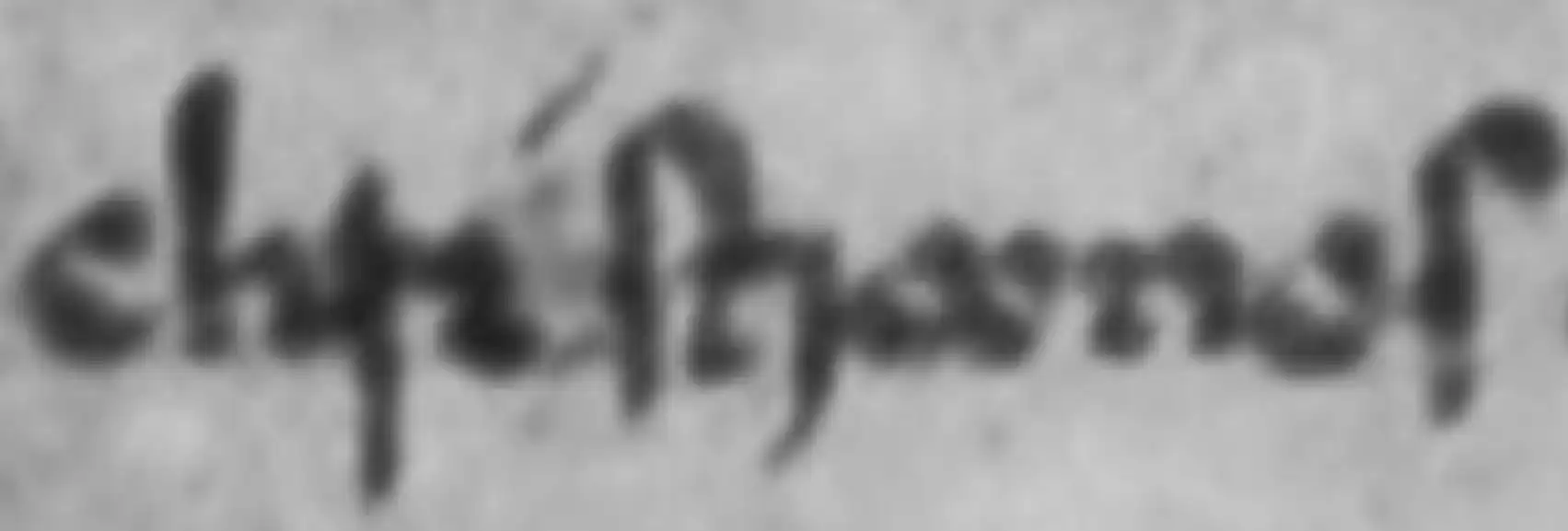
Source claim (summary): The oldest manuscript contains a visible edit and a marginal note specifying "Christians." A UV scan shows discoloration where the ink was scratched out, revealing an "e."
This is true, it is well known, and it is printed in the critical apparatus of modern editions. Teresa Lodi, then director of the Laurentian Library, concluded that an e had been erased and reworked into an i; Ida Giovanna Rao repeated the examination in 2008 and reached the same conclusion.
But notice which way the evidence runs. The original reading was chrestianos; a later hand normalised it to the familiar Christian spelling. Modern editors accordingly print chrestianos – the awkward reading – as what Tacitus wrote. The erasure is a medieval scribe tidying an unfamiliar word, which is among the most common events in manuscript transmission.
…Nero fastened the guilt and inflicted the most exquisite tortures on a class hated for their abominations, called Chrestians by the populace. Christus, from whom the name had its origin, suffered the extreme penalty during the reign of Tiberius at the hands of one of our procurators, Pontius Pilatus…
the original reading, later erased to 'Christianos'Tacitus's own derivation, untouched by the corrector
Now ask what a Christian forger would have written. He would have written Christianos. He would not have invented a misspelling that a later Christian scribe then had to correct back. The manuscript evidence the site presents as proof of Christian tampering is evidence that the text as first written was not shaped by Christian usage.
"Calling them 'Chrestians' and then deriving the name from 'Christus' is nonsensical"
Source claim (summary): Using the spelling Chrestians and then saying they're named after Christus is nonsensical. Tacitus also uses the Greek variant Chrestianos instead of the Latin Chrestianus.
It is not nonsensical; it is a standard Latin construction, and it is the sort of remark that only makes sense from an outsider.
Tacitus writes quos per flagitia invisos vulgus Chrestianos appellabat – "whom the crowd called Chrestians because of their outrages." He is reporting popular usage, and reporting it with contempt, then supplying the correct derivation himself: auctor nominis eius Christus, "the originator of that name was Christus." That is a learned aside distinguishing what the mob said from what was actually the case, which is exactly the register Tacitus writes in throughout.
The Chrestus/Christus confusion is independently attested – Suetonius records Claudius expelling Jews from Rome over disturbances impulsore Chresto (Claudius 25) – because in Greek of this period χρηστός and Χριστός were near-homophones, and chrestos ("useful, good") was a real and common word while Christos ("anointed") meant nothing to a Latin speaker. Pagans getting the name wrong in precisely this way is documented well enough that Tertullian complains about it directly (Apology 3).
Christian writers do not call themselves Chrestians. The passage preserves the outsider's error, and then corrects it the way a Roman antiquarian would.
"He calls Pilate a procurator when Pilate was a prefect — and he knew the difference"
Source claim (summary): He incorrectly calls Pilate a procurator instead of a prefect. While it is true that procurator was expanded in the 40s, the first being Cuspius Fadus, Tacitus makes a clear distinction between the titles nineteen chapters earlier in Annals book 15 chapter 25, and uses "prefect" 77 times elsewhere.
The observation is correct. The Pilate Stone, found at Caesarea Maritima in 1961, gives Pilate's title as praefectus Iudaeae, and P. A. Brunt showed that equestrian provincial governors were regularly styled procurator only from Claudius onward. The Dickinson College commentary on Annals 15.44 flags the word as an anachronism without hesitation.
Three things follow, none of them the one the site draws.
First, this is what everyone did. Josephus, writing in the 70s–90s, calls Pilate ἐπίτροπος – the Greek equivalent of procurator (Jewish War 2.169). Philo of Alexandria, who was Pilate's actual contemporary and had every reason to know, uses the same word of him (Embassy to Gaius 299). If using the later title convicts Tacitus of forgery, it convicts a contemporary Alexandrian Jew of forging Philo.
Second, the "77 prefects" list does not show what it is offered to show. Those passages overwhelmingly concern praetorian prefects, urban prefects, fleet prefects and camp prefects – different offices entirely. Knowing that the praetorian prefect is called praefectus tells you nothing about whether a senator writing under Hadrian knew the precise equestrian title used in a minor province eighty years earlier, when the standard usage of his own day was procurator.
The Annals 15.25 citation is real, and it does not carry the weight put on it. The page has sharpened this argument, and the sharpening deserves a direct answer rather than a restatement. Tacitus does write, at 15.25, of "tetrarchs, kings, prefects, procurators and praetors governing neighbouring provinces" receiving orders to obey Corbulo. So he plainly knew the two words named different things.
But look at what that sentence is doing. It lists the categories of subordinate authority operating in the East in 62 CE, the year the narrative has reached, as a chain of command. It is not a statement about which title a particular governor of Judaea held thirty years earlier, under a different emperor and before the administrative reorganisation the page now concedes took place in the 40s. Knowing that prefects and procurators are distinct offices in your own day is not the same as knowing which of them a minor equestrian held two generations back, in a province whose arrangements had since changed. Historians writing about the recent past retroject current titles constantly, and Tacitus is no exception.
And the argument still proves too much, because of the company it puts the page in. Philo of Alexandria was Pilate's contemporary, wrote while Pilate was in living memory, had direct political reasons to describe the office accurately, and calls him ἐπίτροπος – procurator. Josephus does the same. If using the later title is evidence that a passage was forged by someone ignorant of first-century Judaean administration, then the forgers include a Jewish philosopher who was petitioning the emperor about Pilate's conduct at the time. The page's own newly added concession, that the title genuinely was expanded in the 40s under Fadus, is what dissolves the objection: after that point procurator simply was the word for the job, and everyone used it backwards.
Third, and decisively: the anachronism is an argument against Christian authorship. Forgers copy from their sources. The Gospels never call Pilate procurator; they call him ἡγεμών, "governor" (Matthew 27:2, Luke 20:20). A Christian interpolator inserting this sentence would have taken his vocabulary from the Gospels, or from the creed. Instead the passage uses a Roman administrative term that fits the writer's own era and not the Christian source tradition. That is a fingerprint of Roman authorship, and the site presents it as the opposite.
"He gives no source, no name, no date and no crucifixion"
Source claim (summary): He provides no sources; he gives a title (Christus) without a name; instead of a date he gives only "during Tiberius' reign," a window of 22 years; and he doesn't mention crucifixion, only that someone suffered "the extreme penalty."
Each of these is an ordinary feature of Tacitus, and three of them are further problems for the forgery thesis.
No sources cited. Tacitus names a source perhaps a dozen times in the surviving Annals – Pliny the Elder, Fabius Rusticus and Cluvius Rufus, and usually only when they disagree with one another. Silent use of sources is his default. If unattributed reporting marks a passage as interpolated, nearly the whole work is interpolated.
A title, not a name. Tacitus is explaining where the name "Chrestians/Christians" came from. The only word that does that job is Christus. Adding "Jesus" would have explained nothing, and Roman writers of this period generally knew the figure by the cult title alone. Once again, a Christian forger writing in the second century would have written Christus Iesus – the phrase is all over Paul and the Apostolic Fathers.
Dating by reign. Tacitus is here in a digression from his annalistic frame, explaining the origin of a group in a chapter about the year 64. Dating an event outside the narrative year by the reigning emperor is normal practice. He also gives the governor – which narrows the "22-year window" to Pilate's prefecture, 26–36 CE.
"The extreme penalty." Supplicio adfectus erat is the standard Roman idiom for capital punishment, used the way an English speaker says "was executed." What is telling is what is missing: a Christian interpolator would have named the cross. The cross is the centre of Christian devotional language; second-century Christians did not describe the crucifixion as an unspecified supplicium. The passage is written by someone for whom the execution of a provincial troublemaker is an unremarkable administrative fact.
"No other source records Nero blaming Christians for the fire"
Source claim (summary): No other contemporary historian mentions Christians being persecuted by Nero for the fire. Suetonius writes about the fire but doesn't associate the Christians with it. Tertullian says only "consult your histories," and Sulpicius Severus is fourth-century — possibly the real source of the interpolation.
The page's most substantial argument deserves a straight answer: there is a serious scholarly case that the fire connection is not historical. Brent Shaw argued exactly that in the Journal of Roman Studies in 2015, and it provoked a real debate; Christopher Jones replied in New Testament Studies in 2017, and Shaw responded again.
But look at what Shaw actually concludes. In his own abstract: "The only source for this event is a brief passage in the historian Tacitus. Although the passage is probably genuine Tacitus, it reflects ideas and connections prevalent at the time the historian was writing and not the realities of the 60s."
The strongest modern sceptic of the Neronian persecution treats Annals 15.44 as authentic Tacitus. His argument is that Tacitus, writing in 116, retrojected a later understanding of Christians onto 64 – which, if correct, tells us that Christians were a recognisable group with a founder called Christus by Tacitus's own day, on hostile Roman information. It does not remove the sentence about Pilate; it dates the framing.
On Suetonius: he does record Nero punishing Christians – afflicti suppliciis Christiani, genus hominum superstitionis novae ac maleficae (Nero 16.2) – in a list of Nero's measures, simply not tied to the fire. That is independent attestation of Neronian action against Christians, from a writer with access to imperial archives.
On circularity: Tertullian's "consult your histories" (Apology 5) is evidence that he expected a pagan reader to be able to verify Neronian action against Christians in standard Roman histories. The proposal that Sulpicius Severus (c. 400) is the true author of the Tacitus passage requires that a Christian chronicler wrote contemptuous Tacitean Latin about a "deadly superstition" and "hatred of the human race," inserted it into a text that then had to reach Monte Cassino, and left no trace of the operation. It is not impossible. It is simply not supported by anything.
"Stylometry provides additional evidence of interpolation"
Source claim (summary): The reference to and details about Christians after the mention of the Chrestians in Annals 15.44 is an interpolation. Stylometry provides additional evidence of its interpolation.
The disputed sentence is very short. That makes validation important; it does not make authorship attribution mathematically impossible. The relevant question is how reliably this particular procedure distinguishes comparable Latin passages of known authorship.
Eder's sample-size results are empirical benchmarks for tested corpora, not a universal minimum. Short-text studies use different features and validation designs. The stylometry article distinguishes those results and supplies the primary research links.
An unusual position in a cluster may reflect author, subject, genre, textual transmission or sampling effects. Establishing interpolation requires showing why that explanation fits better than the alternatives; the tree alone does not establish it. This site has not independently replicated the analysis or measured its error rate.
"Tacitus doesn't mention any Pope or apostolic succession"
Source claim (summary): Tacitus doesn't mention any Pope or apostolic succession. The list of Popes says they were on their 7th Pope by 116 CE.
Nor would he. Tacitus devotes a single paragraph to Christians, in a chapter about a fire, in order to explain who Nero burned. He also does not name a bishop of Alexandria, a synagogue archon, or any officer of any of the other foreign cults he mentions with contempt.
More to the point, the papal list this argument depends on is a later reconstruction: the historical consensus is that Rome had no single monarchical bishop until well into the second century, and was led by a group of presbyters before that.2 The argument uses a piece of church tradition that critical scholarship rejects, and then treats a Roman historian's failure to corroborate that tradition as evidence against Christian origins. The tradition being absent from Tacitus is what the historical account predicts.
Full bibliography
- Tacitus, Annals 15.44. Latin text and commentary: Dickinson College Commentaries; text at Perseus.
- Brent D. Shaw, "The Myth of the Neronian Persecution," Journal of Roman Studies 105 (2015), 73–100. Cambridge Core
- Christopher P. Jones, "The Historicity of the Neronian Persecution: A Response to Brent Shaw," New Testament Studies 63 (2017), 146–152. Cambridge Core
- Maciej Eder, "Does size matter? Authorship attribution, small samples, big problem," Digital Scholarship in the Humanities 30/2 (2015), 167–182. Oxford Academic
- Robert E. Van Voorst, Jesus Outside the New Testament: An Introduction to the Ancient Evidence (Grand Rapids: Eerdmans, 2000), ch. 2 – the standard survey of the classical references, including the argument that the passage's hostility tells against Christian authorship.
- P. A. Brunt, "Procuratorial Jurisdiction," Latomus 25 (1966), 461–489 – on the praefectus/procurator transition under Claudius.
- The Pilate Stone (Caesarea Maritima, 1961), giving [Pon]tius Pilatus … praef[ectus] Iuda[ea]e. Israel Museum, Jerusalem.
- Josephus, Jewish War 2.169; Philo, Embassy to Gaius 299 – both using ἐπίτροπος of Pilate.
- Suetonius, Nero 16.2; Claudius 25.4.
- Tertullian, Apology 3 (on the Chrestianus misspelling) and 5 (on Nero).
- L. D. Reynolds (ed.), Texts and Transmission: A Survey of the Latin Classics (Oxford: Clarendon, 1983) – on the manuscript transmission of Tacitus and the Latin classics generally.
Figures
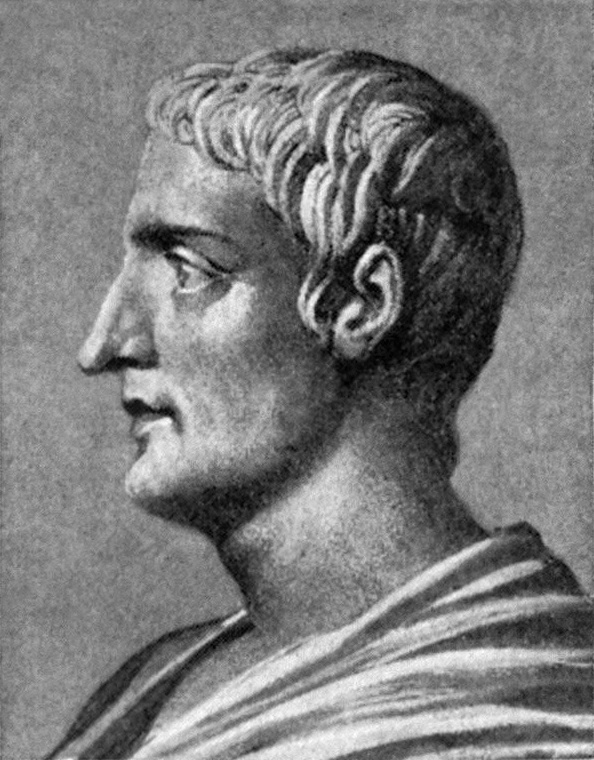
- Fig. 1 · Statue of Tacitus outside the Austrian Parliament, Vienna. Wikimedia Commons
- Fig. 2 · The source site’s UV image of Codex Mediceus II at Annals 15.44: the erased e of chrestianos – the reading modern editors print as original. mythicism.web.app