Relics
Thirty-one foreskins, competing robes, undated thorns – agreed, all of it, and Calvin said it funnier in 1543. Medieval relic-fraud is evidence about medieval piety and commerce. No historical case for Jesus has ever cited a relic.
Responding to mythicism.web.app/relics
The response here is mostly a handshake. The medieval relic trade produced fakes on an industrial scale; the church's own reformers said so; modern scholarship confirms it. The remaining work is to say precisely what this does and does not bear on, then pull out the one item on the list that is not a relic at all, because it is actually interesting.
"The relics are forgeries"
Mythicist claim: The Holy Prepuce was claimed by as many as 31 churches. The Sandals of Jesus first appear in the 8th century with medieval decoration. Several robes exist, one first mentioned in 1156. The Crown of Thorns is first mentioned in the early 5th century, has travelled from Jerusalem to Constantinople to Paris, and has never been scientifically dated. There are at least five rival tombs, from Jerusalem to Kashmir to Japan.
Agreed, comprehensively. No relic of Jesus has a documented chain of custody reaching anywhere near the first century; every one surfaces centuries later, at the intersection of pilgrimage economics and imperial politics (Helena's fourth-century relic-finding tour is the industry's founding event). The multiplicity is self-refuting – thirty-one prepuces, multiple seamless robes, enough True Cross fragments that Calvin quipped a ship couldn't carry them, and tombs in Jerusalem (twice), Talpiot, Kashmir and Aomori, Japan. The church's own critics got here first: Guibert of Nogent attacked relic-fraud in the 1120s; Calvin's Treatise on Relics (1543) remains the classic demolition; and no critical historian since has treated any Jesus-relic as authentic. The Shroud – the one relic with modern lab results – gets its own page, where the radiocarbon verdict is accepted without reservation.
So the concession is total, and the boundary is short: the historical case for Jesus cites no relics. Ehrman, Sanders, Meier, Fredriksen, Casey – no relic appears in any of them, because the case runs on first-century texts (Paul, the gospel traditions) and hostile notices (Josephus, Tacitus). Medieval forgeries postdating the man by a millennium can no more count against his existence than fake Lincoln memorabilia counts against Lincoln. What the relic trade actually attests is the demand side: by late antiquity, Jesus's historical reality was so universally assumed – by forgers, buyers, critics and iconoclasts alike – that physical contact with it commanded a premium. People do not counterfeit currency that nobody believes in.
Two items on the page's list deserve separate handling, because they aren't relics:
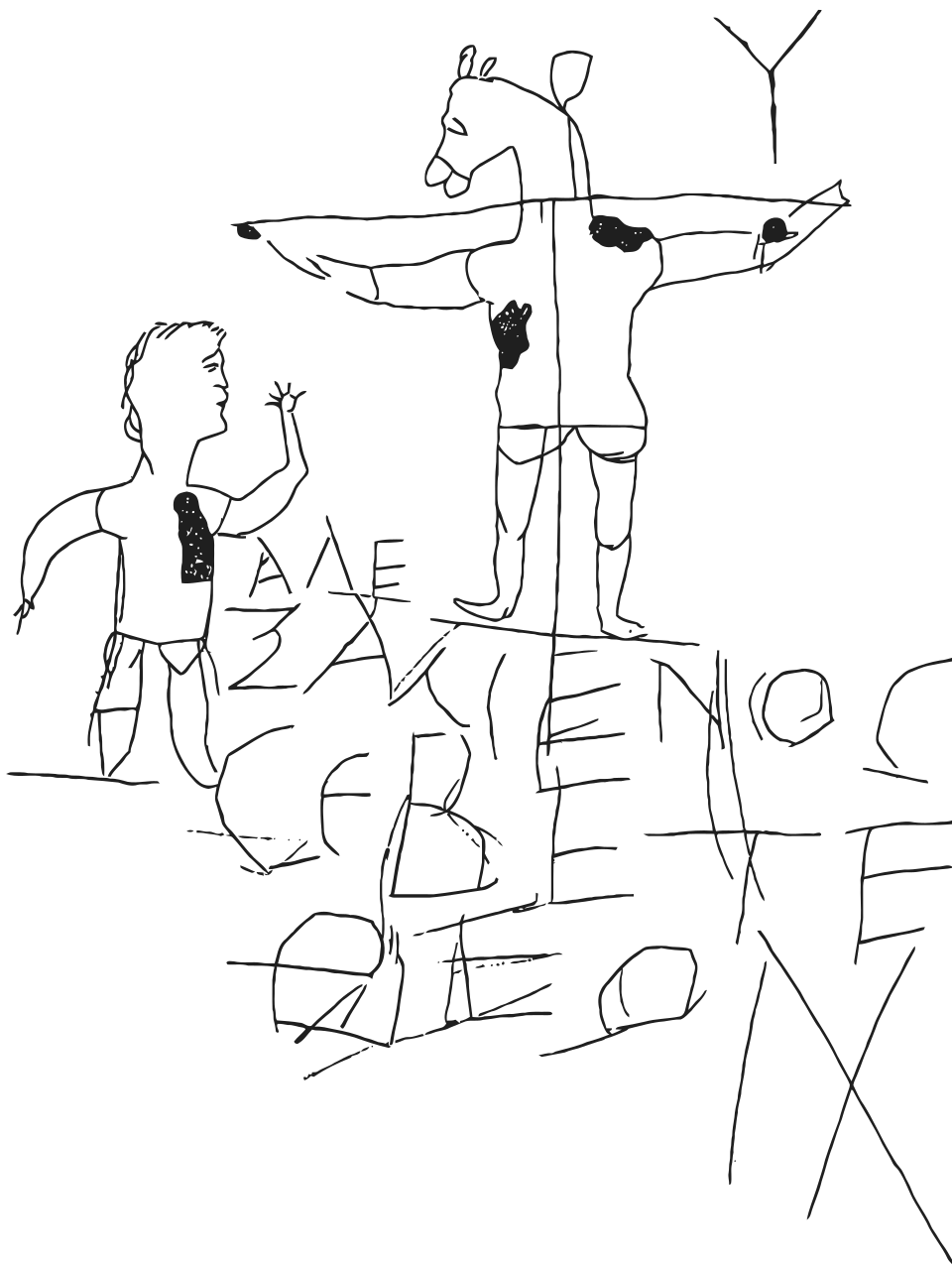
The Alexamenos graffito is the opposite of a Christian forgery – it is anti-Christian graffiti, scratched into plaster on the Palatine (usually dated late 2nd – early 3rd century): a donkey-headed figure on a cross, a young man raising a hand, and the mocking caption "Alexamenos worships [his] god" (Alexamenos sebete theon). The page's "it doesn't say Jesus or Christians" is technically true and beside the point recognised by the scholarship: a crucified god being worshipped, mocked with the donkey-head slander that Tertullian and Minucius Felix tell us pagans aimed at Christians specifically, in the palace pages' quarters. It is standardly read as our earliest surviving image of the crucifixion – drawn by a scoffer. As evidence it belongs with Lucian and Celsus: outsiders in the second and third centuries uniformly understood Christians to worship a crucified man, and ridiculed exactly that.
The Megiddo mosaic is a floor from a 3rd-century Christian prayer hall near Legio, inscribed "to God Jesus Christ" with the name in nomina sacra (the standard Christian scribal abbreviation – the page's observation is correct and unremarkable, since that is how Christians wrote the name in every manuscript too). It is archaeology of the early church, not a relic claim; nobody argues it touches Jesus. It attests a Christ-worshipping community in Roman Palestine before Constantine – context, not proof, and claimed as nothing more here.
Full bibliography
- John Calvin, Traité des reliques (1543; ET in Tracts and Treatises, vol. 1).
- Charles Freeman, Holy Bones, Holy Dust (New Haven: Yale UP, 2011).
- Larry W. Hurtado, The Earliest Christian Artifacts (Grand Rapids: Eerdmans, 2006).
- Yotam Tepper & Leah Di Segni, A Christian Prayer Hall of the Third Century CE at Kefar 'Othnay (Jerusalem: IAA, 2006).
- Guibert of Nogent, De sanctis et eorum pigneribus (c. 1120).
Figures
- Fig. 1 · Tracing of the Alexamenos graffito (Palatine, c. 200 CE): "Alexamenos worships his god". Wikimedia Commons