Talmud
Late, hostile, garbled, and polemical – everything the page says, and Schäfer's scholarship says it better. Which is exactly why the Talmud's mode of attack matters: centuries of motivated Jewish counter-narrative, and the counter-narrative is "justly executed," never "never existed."
Responding to mythicism.web.app/talmud
The rabbinic references to Yeshu are late (the Babylonian Talmud reached its form in the 3rd–6th centuries), scattered, censored and re-inserted across editions, and openly polemical. The page reports this accurately, and its account tracks the standard scholarly treatment – Peter Schäfer's Jesus in the Talmud – closely enough that there is little to correct. What remains is to weigh the exhibit properly, because weighed properly it points the other way.
"The Talmud's Yeshu is late polemic, inconsistent with the New Testament"
Mythicist claim: The Talmuds use satire and counter-narratives to delegitimize Christianity. Yeshu is son of Pandera, a Roman soldier (Sanhedrin 67a; Shabbat 104b); "hanged on the eve of Passover" or "going forth to be stoned" (Sanhedrin 43a); a sorcerer with five disciples — Matthai, Naqqai, Netzer, Buni, Todah; punished in boiling excrement (Gittin 56b–57a).
All correctly reported, with one small correction: the "Yimach Shemo" acronym reading of Yeshu is a mediaeval and popular etymology, not the scholarly one – Yeshu is most likely simply the Galilean-Aramaic form of the name with the final ayin dropped, though the curse-acronym became a living pun later. Minor point.
On the substance, mainstream scholarship agrees with the page's framing and has sharpened it: Schäfer's study argues these passages are deliberate counter-narrative – the Bavli's authors, safely in Sasanian Babylonia beyond Christian imperial reach, retelling the Christian story as its inversion. Mary the adulteress with the soldier Pandera inverts the virgin birth (and note: Pandera is the same name Celsus's Jewish source used c. 175 – see Celsus – so this polemical stream is old even if the Talmud's redaction is late). The sorcerer "who practised magic and led Israel astray" inverts the miracle-worker. The five mock-named disciples are executed in a pun-sequence. "Hanged on the eve of Passover" – with a herald going out forty days seeking exculpatory witnesses and finding none – inverts the unjust-trial narrative into a scrupulously fair one. The boiling-excrement scene inverts the exalted Christ. None of this is independent historical memory of the 30s CE; Schäfer is emphatic, and this site takes his side against apologetic overuse of Sanhedrin 43a as "Jewish confirmation of the crucifixion details."
So graded, the Talmud is worth little as direct evidence – and this site claims little. But now ask the question the page never asks: what does centuries of motivated Jewish counter-narrative choose to contest? The paternity. The mother's virtue. The source of the powers. The legitimacy of the verdict. The afterlife fate. What it never contests, in any stratum, in any edition, censored or uncensored – from Celsus's Jew in the 170s through the Bavli to the mediaeval Toledot Yeshu, the full polemical tradition running a thousand years – is that there was a Yeshu ha-Notzri to attack. The community with the oldest continuous adversarial relationship to Christianity, with rich internal traditions and every conceivable motive to deploy "your founder is a fable" if such a memory existed anywhere in Jewish tradition, instead built its entire polemic on a discreditable man who was justly executed. Counter-narratives concede the narrative's subject; you cannot invert a story about nobody.
The pattern is now complete across every hostile witness this site has reviewed: Celsus, Lucian, Trypho's Judaism and the Talmud. Antiquity's opposition bench is full, pagan and Jewish, without one occupant of the mythicist position. The page's title claim – "does not provide evidence for Jesus's existence" – is true of the Talmud taken alone and late. Read as the terminus of a polemical tradition reaching back to within a century of the events, however, its silence about non-existence is loud.
Full bibliography
- Peter Schäfer, Jesus in the Talmud (Princeton: PUP, 2007).
- Robert E. Van Voorst, Jesus Outside the New Testament (Grand Rapids: Eerdmans, 2000).
- Origen, Contra Celsum, trans. Chadwick (Cambridge: CUP, 1953).
- b. Sanhedrin 43a, 67a; b. Shabbat 104b; b. Gittin 56b–57a; b. Berakhot 17b.
- On Toledot Yeshu: Michael Meerson & Peter Schäfer, Toledot Yeshu: The Life Story of Jesus, 2 vols. (Mohr Siebeck, 2014).
Figures
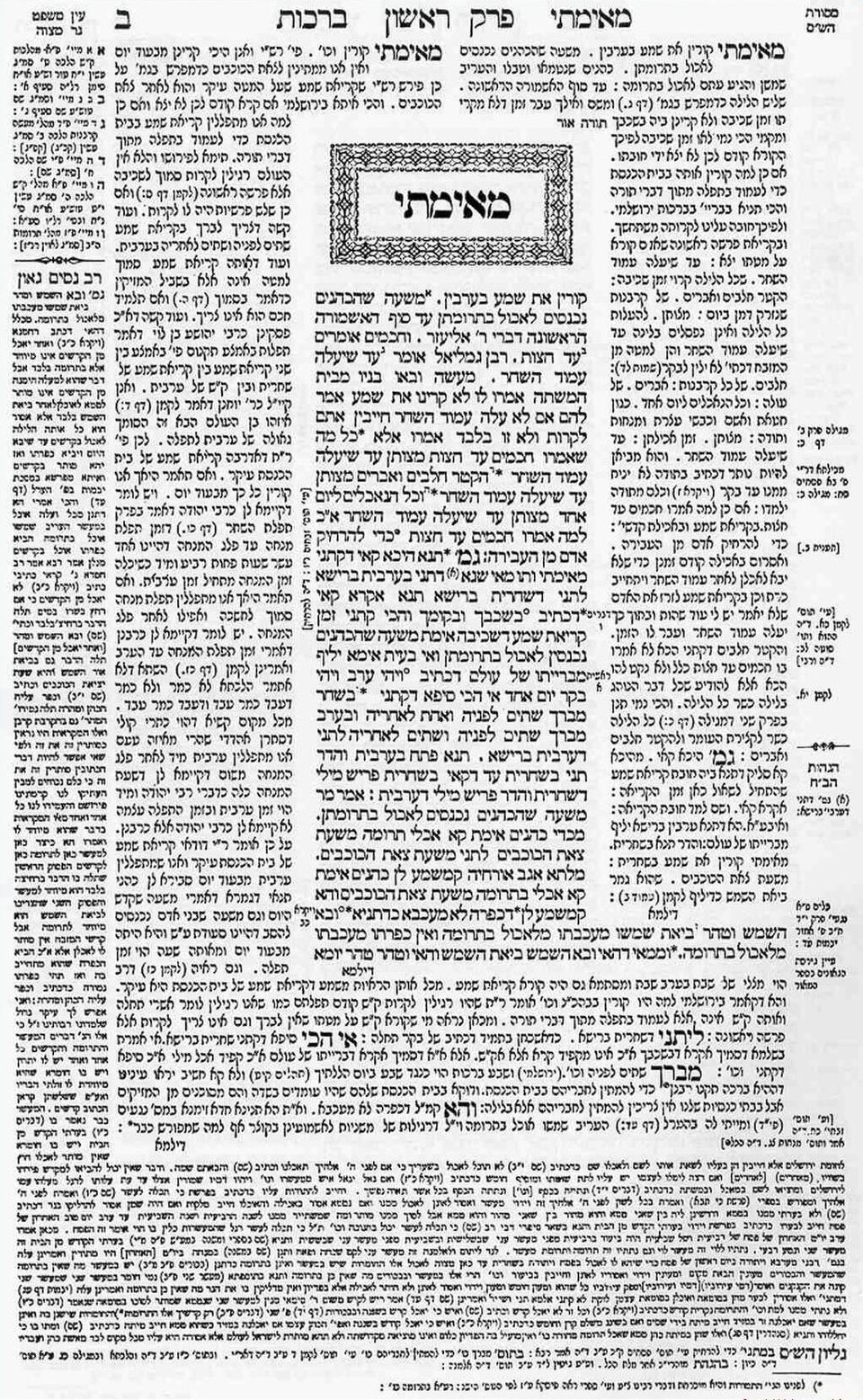
- Fig. 1 · Berakhot 2a, the opening page of the Babylonian Talmud in the Vilna edition. Wikimedia Commons