Phlegon
Agreed almost throughout – Phlegon recorded an eclipse and earthquake with no connection to Jesus, and the "clearly this is the one" gloss is a later scribal addition. Another apologetic exhibit that scholarship never admitted into evidence.
Responding to mythicism.web.app/phlegon
Phlegon of Tralles, a freedman of Hadrian, compiled an Olympiads chronicle in the second century. It survives only in fragments quoted by later writers. Like Thallus – with whom he travels in the same paragraph of the same ninth-century source – he enters this debate only because apologists once pressed him into service as a witness to the crucifixion darkness. The source page argues the service was illegitimate. It was.
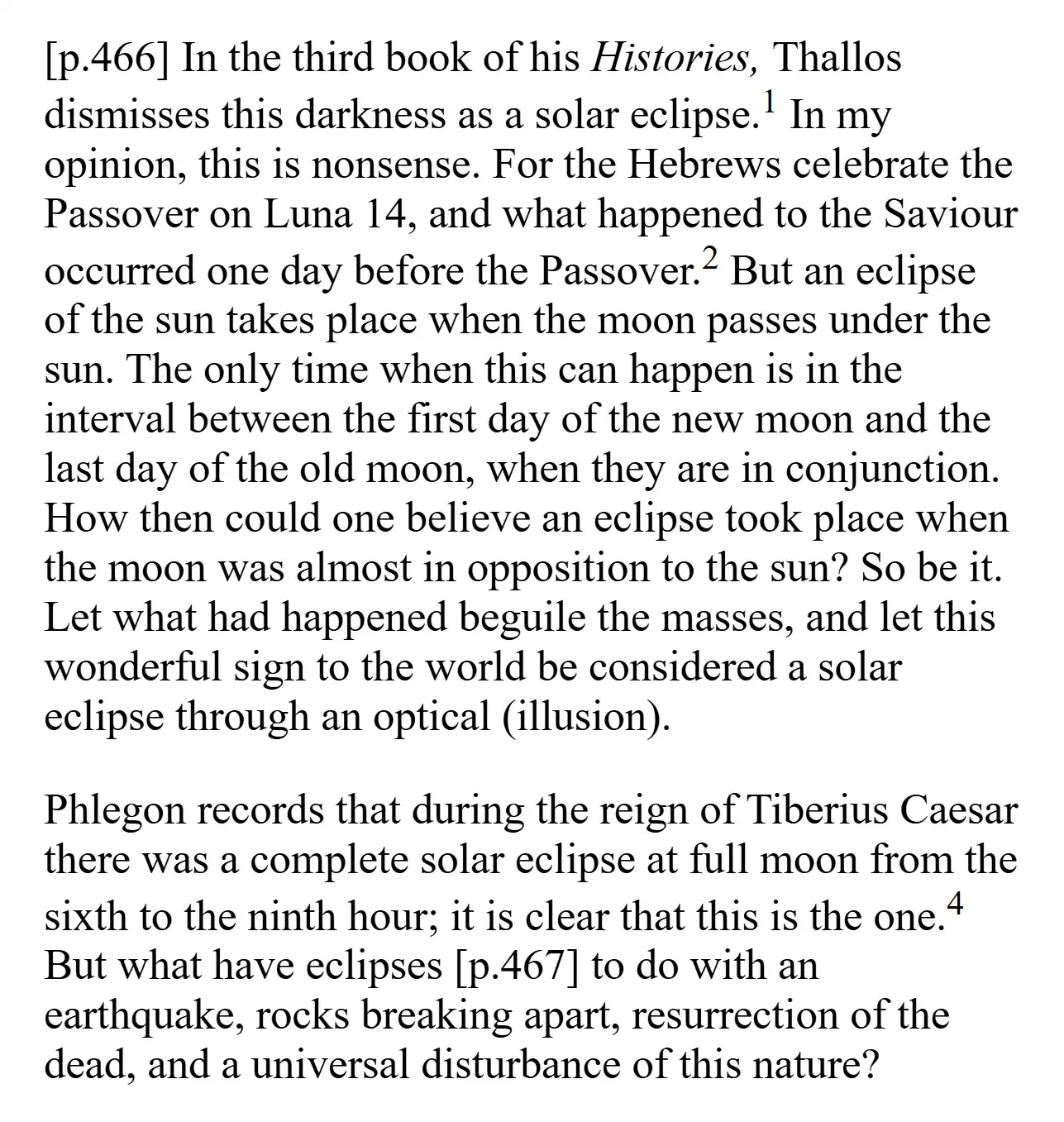
"Phlegon recorded an eclipse and earthquake — with no reference to Jesus"
Mythicist claim: Phlegon mentioned an eclipse during Tiberius's reign but, as Origen notes, "did not say that it happened during the full moon." The "it is clear that this is the one" phrase in Africanus is a later scribal addition. Eusebius's verbatim quotation of Phlegon — attested in Greek, Jerome's Latin, the Syrian epitome and Armenian — contains no reference to Jesus. The earthquake was in Nicaea, over 500 miles from Judea.
Essentially all correct, and worth setting out cleanly because the underlying texts are a mess of quotations-within-quotations.
What Phlegon appears to have recorded (via Eusebius's quotation, the best-attested fragment): in the 202nd Olympiad (32/33 CE), a great eclipse of the sun, "night at the sixth hour of the day," stars visible, and an earthquake in Bithynia toppling much of Nicaea. Astronomers have long matched this to the solar eclipse of 24 November 29 CE, whose path crossed Bithynia – a real, natural, datable event in north-west Asia Minor. No Jesus, no Judaea, no full moon, no three hours. The connection to the crucifixion was made for Phlegon by Christian writers wanting pagan confirmation of the Gospel darkness – and the site is right that the connective tissue ("it is clear that this is the one") shows the marks of scribal addition rather than Africanus's own argument, since Africanus had just finished objecting that a natural eclipse at Passover is impossible.
Origen's testimony deserves the emphasis the page gives it: he cites Phlegon three times (Contra Celsum 2.14, 2.33, 2.59), claims Phlegon granted Jesus foreknowledge "though confusing things about Peter with things about Jesus," and – decisively – concedes that Phlegon did not say the eclipse fell at full moon. When your own third-century apologist admits the pagan chronicle doesn't match the Gospel event, the exhibit is closed. Modern scholarship treats the Phlegon fragments accordingly: as evidence for a Bithynian eclipse-and-earthquake report, not for anything in Judaea. (Whether Phlegon's original mentioned Jesus at all is doubtful; if his lost Olympiads said anything, it was likely secondhand from Christian claims a century after the fact – worthless either way, as Origen's "confusing Peter with Jesus" itself suggests.)
So: conceded, with the same closing observation as Thallus. The Gospel darkness is a theological motif (Amos 8:9 patterning), not an astronomical report; no critical case for the historicity of Jesus cites Phlegon; and striking him from the record subtracts nothing from Paul, Josephus, Tacitus, or the gospel traditions. A bad apologetic argument has been correctly retired – by critical scholarship first, and by this page second.
Full bibliography
- Felix Jacoby, Die Fragmente der griechischen Historiker, 257 F 16–17 (Phlegon).
- Origen, Contra Celsum 2.14, 2.33, 2.59; Commentary on Matthew (on 27:45).
- F. R. Stephenson, Historical Eclipses and Earth's Rotation (Cambridge: CUP, 1997).
- Robert E. Van Voorst, Jesus Outside the New Testament (Grand Rapids: Eerdmans, 2000).
- George Syncellus, Chronographia (ed. Mosshammer).
Figures
- Fig. 1 · The Syncellus passage transmitting Africanus on Thallus and Phlegon, as displayed on the source site. mythicism.web.app