Didache
Everything the page says about the Didache is roughly right – anonymous, composite, non-canonical, non-Pauline. What it doesn't say is what any of that is evidence against. A Torah-flavoured church manual invoking "the God of David" fits a Judaean founder-movement exactly.
Responding to mythicism.web.app/didache
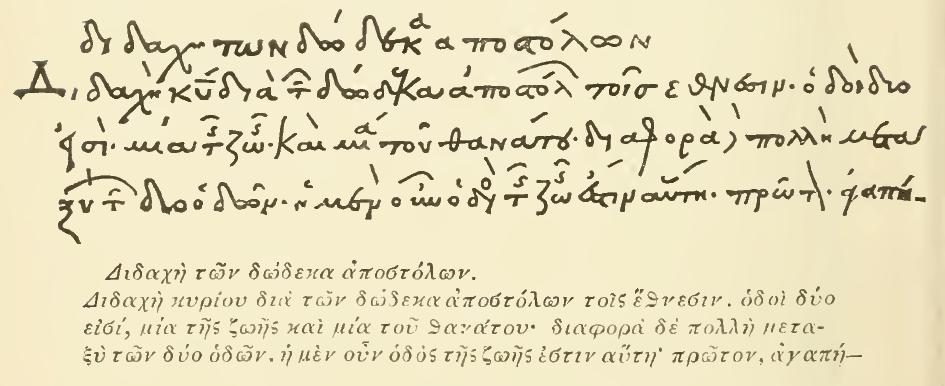
The Didache is a short, anonymous church manual – ethics ("the Two Ways"), baptism, fasting, eucharistic prayers, itinerant-prophet regulations – rediscovered in 1873 in an 1056 manuscript. The page's factual summary is broadly accurate. What is missing is an argument: nothing on the page connects any of these facts to the question this site exists to argue about.
"Anonymous, composite, late-or-early, rejected from canon, lost for centuries"
Mythicist claim: Dated as early as the first century but as late as 150. Anonymous. Not accepted into canon — Eusebius lists it among rejected writings; Athanasius calls it useful but not canonical. A composite, not backed by hard evidence. Lost until 1873.
All essentially correct, and none of it contested territory. The scholarly mainstream (Niederwimmer's and Milavec's standard commentaries; the Audet tradition dating it very early) treats the Didache as a composite community rule, its parts ranging from mid-first century to early second, compiled perhaps around the turn of the century in rural Syria. Anonymity is what a community rulebook looks like – nobody signs a liturgy. Its canonical rejection is fourth-century librarianship doing its declared job – Eusebius and Athanasius sorted by apostolic authorship, and the Didache's title-page claim to apostolic teaching was exactly the kind of claim the sorting was designed to test. The manuscript story (Bryennios's 1873 find, the 1900 Latin fragment) is told correctly.
So the exhibit is: an early, anonymous, non-canonical church manual exists. As evidence against a historical Jesus, this is null – a rulebook's anonymity and canon-status say nothing about the founder of the movement whose meals and baptisms it regulates. But read as evidence about the early movement, the Didache is quietly awkward for mythicism, in three ways the page never mentions:
- Its Jesus-material is synoptic-shaped teaching, not celestial speculation. The Two Ways ethics interleave sayings paralleling the Sermon on the Mount; the community prays "Our Father" three times daily (8.2–3, "as the Lord commanded in his gospel"). Whether that is Matthew-dependence or shared oral tradition (both positions live in the literature), a c. 100 rural community's Jesus is a teacher whose sayings regulate life – exactly the wrong shape for a purely heavenly being, and exactly the shape of a remembered rabbi.
- Its eucharistic prayers (9–10) are intensely Jewish – reworked table blessings thanking "our Father" for "the holy vine of David your servant, which you made known to us through Jesus your servant." The movement's cult meal, in its earliest liturgical text, is a Jewish meal-blessing centred on a Davidic figure – continuous with a Galilean-Judaean origin, discontinuous with derivation from mystery cults.
- Its church order is primitive. Wandering apostles and prophets tested by rules of thumb (11: a prophet who stays three days, or asks for money, is false), with resident bishops and deacons just emerging (15). That is an earlier organisational stratum than Ignatius's monepiscopacy – which is why scholars date it early, and why it documents the transitional decades mythicism needs to be empty of ordinary institutional memory.
"It depends on Matthew but lacks Pauline influence — where is the apostle to the Gentiles?"
Mythicist claim: It appears dependent on Matthew but lacks Pauline influence. If traditional dating is used it postdates Matthew, yet tradition says most apostles died 60–80 CE. If Paul was as influential as claimed, wrote as early as claimed, and was the "apostle to the Gentiles," this teaching to the Gentiles lacks any authoritative input from him.
The page's one real argument assumes Paul already held the universal status later Christianity gave him. His own undisputed letters are one long complaint that his influence was contested and regional: churches in Galatia defect to rival teachers, Corinth splits into parties ("I belong to Cephas…"), Jerusalem's pillars need persuading, "false brothers" dog him, and whole missions (Apollos's, Cephas's, the "men from James") operate on other lines. The New Testament itself preserves an anti-Pauline or non-Pauline stream. Matthew's gospel, the very text the Didache breathes alongside, insists every jot of the Law stands (Matt 5:17–19), while James pointedly reworks "faith apart from works." Critical scholarship has mapped these currents for two centuries: Jewish-Christian communities in Syria-Palestine that revered Jesus as teacher and messiah while ignoring or opposing Paul, surviving into the Ebionites of the patristic era.
The Didache is a document from that stream – Torah-shaped ethics, Matthean-style piety, Jewish table prayers, Gentile converts catechised into a Judaic frame. Its Paul-lessness is not a hole in the record; it is a datum confirming the record's texture: earliest Christianity was plural, regional, and quarrelsome, exactly as Paul's own letters describe from the other side of the quarrel. On the mythicist model – where Paul's letters are supposedly the fountainhead of the whole tradition (see Paul, where the site wants the letters to be the first documents) – a flourishing early liturgy with no Pauline fingerprint at all is far harder to explain than on the ordinary model, where a Galilean movement radiated through multiple channels of which Paul was one.
And the "apostles died 60–80" arithmetic misfires: nothing in the Didache claims apostolic composition except the traditional title, which scholars regard as a later label (the page agrees) – the text itself uses "apostle" for living itinerant missionaries (11.3–6), a whole class of people, which is again a mark of the earliest period, before the word narrowed to the Twelve.
Full bibliography
- Kurt Niederwimmer, The Didache: A Commentary (Minneapolis: Fortress, 1998).
- Aaron Milavec, The Didache (New York: Newman Press, 2003).
- Huub van de Sandt & David Flusser, The Didache: Its Jewish Sources (Minneapolis: Fortress, 2002).
- James D. G. Dunn, Unity and Diversity in the New Testament, 3rd ed. (London: SCM, 2006).
- Michael Holmes, The Apostolic Fathers, 3rd ed. (Grand Rapids: Baker, 2007) – text and translation.
Figures
- Fig. 1 · The opening of the Didache in Codex Hierosolymitanus (1056), the manuscript rediscovered in 1873. Wikimedia Commons