Ignatius
The dating debate is real and the traditional 108 CE may well be too early. But re-dating Ignatius to 140 changes nothing – because his letters' entire purpose is to insist, against Christians who denied it, that Jesus was truly born, truly ate, and was truly crucified under Pontius Pilate.
Responding to mythicism.web.app/ignatius
Ignatius of Antioch was transported to Rome and executed sometime between roughly 108 and the 140s; along the way he wrote letters to churches in Asia Minor. The page assembles every doubt about him – dating, authenticity, the Peregrinus identification, the odd route. Some of these doubts are shared by serious scholarship. What none of them touch is what the letters say, which is where this exhibit actually cuts.
"The dating is contested, the manuscripts late, and scholars have called the letters spurious"
Mythicist claim: Eusebius dates his death to 108, but Pervo argues for 140 (Eusebius had ideological interest in early dates; Ignatius seems to quote Ptolemy, active in the 130s). The oldest manuscripts are 11th-century and mixed with pseudepigraphal letters. Calvin called them rubbish; Killen spurious; Zwierlein argues forgery c. 170. Polycarp's letter treats Ignatius dead in ch. 9 but alive in ch. 13. Litwa argues for a mid-2nd-century date.
Sorting the pile:
The authenticity question was settled the hard way, and the page's roster hides the settlement. There are three recensions of Ignatius: a long one (interpolated, everyone agrees), the middle seven-letter collection, and a short Syriac abridgement. The nineteenth century fought a famous philological war over which was genuine – Killen belongs to that war's losing side, and Calvin was reacting to the long recension's forgeries, where his verdict was correct. The war ended with Theodor Zahn and J. B. Lightfoot establishing the middle recension, a result reconfirmed so often that the letters became the textbook case of authenticity criticism succeeding. Quoting Calvin and Killen against the middle recension is quoting pre-Lightfoot opinions against the argument that answered them. (Late manuscripts, again, are the normal condition of ancient literature – see Tacitus – and the middle recension is additionally secured by an Armenian and Syriac transmission and by Eusebius's fourth-century list matching it.)
The dating debate, by contrast, is live and worth conceding. The traditional Trajanic date (c. 108) hangs on Eusebius's chronology, and Eusebius did have systematising interests. A genuine current of recent scholarship – Timothy Barnes, Paul Foster, Pervo, with Zwierlein at the radical end and Litwa popularising – argues for the 130s–140s on various grounds (the possible Ptolemy echo, the developed monepiscopacy, the Polycarp ch. 9/13 tension the page correctly spots, which drove P. N. Harrison's famous two-letter partition of Polycarp). The middle-recension-authentic-but-later position is respectable; total forgery (Zwierlein) remains a distinctly minority verdict. An honest summary: the letters are genuine; their absolute date is uncertain within about thirty-five years.
Now do what the page never does – ask what follows. Move Ignatius to 140 and you have moved a witness within the second century; you have not changed a word he wrote.
"Ignatius might be Peregrinus Proteus"
Mythicist claim: Ignatius could be Peregrinus Proteus, as written about by Lucian (died at the Olympics, 165). Similarities: fascination with martyrdom, Christian background, followers, imprisonment, Christians visiting with gifts, letters sent as "testaments" to Greek cities before death.
The similarity list is genuine – and it is generic. Lucian's satire on Peregrinus depends on his readers recognising a type: the imprisoned Christian celebrity, feted by congregations, showered with delegations and funds, writing farewell letters. Lucian says outright that Christians treat their imprisoned with exactly this circus ("their first lawgiver persuaded them they are all brothers…"; see Lucian). A satirist lampooning a type, and a bishop who instantiated the type a generation earlier, will necessarily resemble each other – that is what types are. The dissimilarities are the identity-killers: Peregrinus apostatised, lived as a Cynic for decades, and self-immolated at Olympia in 165 as a pagan philosopher; Ignatius dies a Christian under Roman sentence, decades earlier on any proposed dating. To merge them you must delete the entire second half of Peregrinus's documented life and re-date Ignatius past even Pervo's boldest number. The thesis lives on a blog (the page's actual source is a Vridar post); it has no purchase in the peer-reviewed literature – even the scholars pushing late dates (Barnes, Foster, Litwa) treat Ignatius and Peregrinus as two people, with Lucian possibly aware of Ignatius's letters as part of the type's furniture. That weaker claim is interesting and harmless.
The "strange route" is neither strange nor evidence. Overland convoy through Asia Minor with long halts is exactly how Roman prisoner transport worked when a detachment had multiple pickups and seasonal constraints on sailing; the cursus along the Lycus and Hermus valleys through Philadelphia and Smyrna is a standard road. Paul's transport in Acts 27 zigzags comparably. Guards taking bribes to allow visitors (Ignatius says his guards get worse "even when treated well" – Romans 5.1, the "ten leopards" passage – implying tips) is documented prisoner experience across the empire (Lucian confirms the visiting-and-gifts culture precisely). And Stevan Davies's "miserly gift" quip cuts against a theory nobody is defending: condemned provincials shipped to Rome for the games went in aggregated batches; Ignatius expects to meet "the beasts" as one of many, not as Syria's entire contribution.
What the letters actually say – the part the page skips
Mythicist claim (page description): Ignatius was an early church father who might also be Peregrinus Proteus.
Here is what the disputed prisoner writes, in the letters whose authenticity survived the nineteenth century's best attack:
"Be deaf, then, to any talk that ignores Jesus Christ, of David's lineage, of Mary; who was really born, ate and drank; was really persecuted under Pontius Pilate; was really crucified and died… He was also truly raised from the dead." — Trallians 9
"…fully persuaded as regards our Lord that he is truly of the family of David according to the flesh… truly nailed for us in the flesh under Pontius Pilate and Herod the tetrarch." — Smyrnaeans 1
And the polemical target, named in the next breath: "if, as some atheists (that is, unbelievers) say, his suffering was only an appearance…" (Trallians 10). Ignatius is fighting docetists – Christians who held Jesus's flesh and suffering to be semblance – and his weapon is a creed of stubbornly historical particulars: Davidic family, Mary, Pilate, Herod, nails.
This is why the dating debate, wherever it lands, does not help the mythicist case – it hurts it at every point on the timeline. Date Ignatius early (108) and you have a bishop, formed in first-century Antioch – Paul's own base – for whom the Pilate-datable execution is bedrock creed. Date him late (140) and you have something just as awkward: proof that when second-century Christians did drift toward a non-fleshly Jesus, the drift was docetism – too divine, never non-existent – and that the church's most combative answer was to nail the story to named Roman officials. On the mythicist model the second century should contain traces of the memory that Jesus was celestial all along, with historicisers innovating against it. What it actually contains is the reverse polarity, documented in the very letters this page works to push later: the "spiritual Jesus" party is the innovation under attack, and the historical particulars are the tradition being defended. No ancient writer on any side of the fight – bishop, docetist, satirist or philosopher – holds the position this website exists to promote.
Full bibliography
- J. B. Lightfoot, The Apostolic Fathers, Part II, 3 vols. (London: Macmillan, 1885).
- Michael Holmes, The Apostolic Fathers, 3rd ed. (Grand Rapids: Baker, 2007).
- Paul Foster (ed.), The Writings of the Apostolic Fathers (London: T&T Clark, 2007).
- Timothy D. Barnes, "The Date of Ignatius," ExpT 120 (2008), 119–130.
- Otto Zwierlein, Die Urfassungen der Martyria Polycarpi et Pionii (Berlin: De Gruyter, 2014) – the forgery thesis, cited for balance.
- Brian Rapske, The Book of Acts and Paul in Roman Custody (Grand Rapids: Eerdmans, 1994).
- Lucian, The Passing of Peregrinus.
- Bart D. Ehrman, Lost Christianities (Oxford: OUP, 2003).
Figures
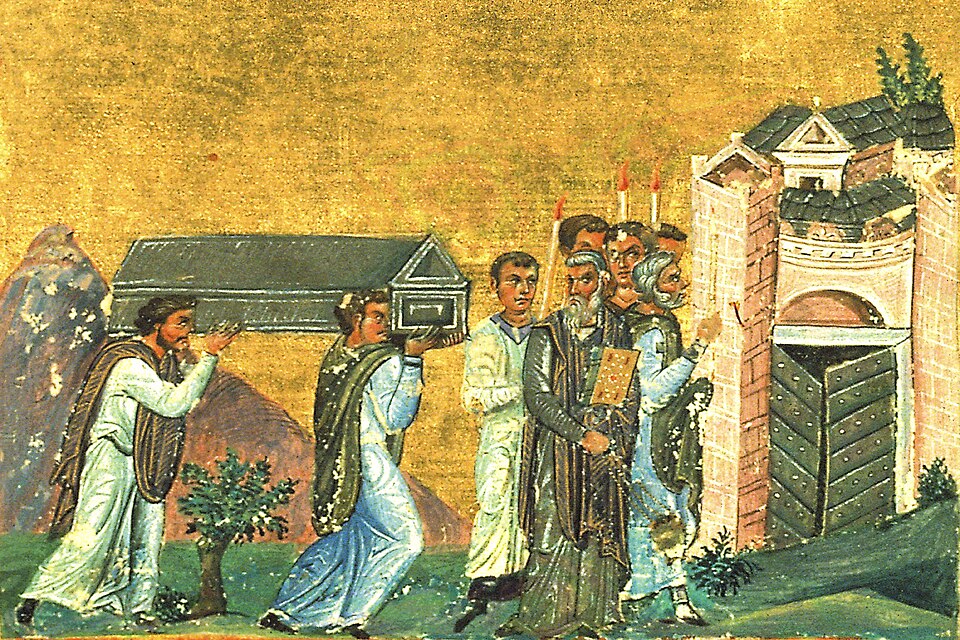
- Fig. 1 · The martyrdom of Ignatius of Antioch in the Menologion of Basil II (c. 1000). Wikimedia Commons