James, the Brother of the Lord
Galatians 1:19 is not an isolated slogan. Paul also distinguishes “the brothers of the Lord” from other apostles, while Josephus identifies James by the same family relationship.
4 sections5 citations1 figure
Paul's meeting with "James, the Lord's brother" is awkward evidence for a theory in which the Lord had never been a man. Three replies recur: Paul meant an ordinary Christian brother; the phrase is an interpolation; or "brother of the Lord" was a special cultic rank. Each reply is possible in isolation. The problem is the evidence around it.
Paul's wording
In Galatians 1:18–19 Paul says that, three years after his call, he visited Cephas in Jerusalem and "did not see any other apostle except James the Lord's brother." Christians call one another brothers throughout Paul's letters, but Paul does not elsewhere call an ordinary believer a brother of the Lord. The added genitive identifies which James he means.[1][3]
The distinction becomes clearer in 1 Corinthians 9:5, where Paul asks whether he lacks the right to travel with a believing wife "as do the other apostles and the brothers of the Lord and Cephas." The brothers are a recognisable group. They are distinguished from apostles generally and from Cephas specifically, and they travel with wives. If every Christian were a "brother of the Lord," the phrase would identify nobody.[1][3]
A cultic title should leave a cultic footprint: multiple bearers, rules for receiving it, or another writer using it that way. None survives. A family description needs only a known family, which Mark 3:31–35 and 6:3, John 7:5, Acts 1:14 and Josephus independently supply.
The interpolation proposal
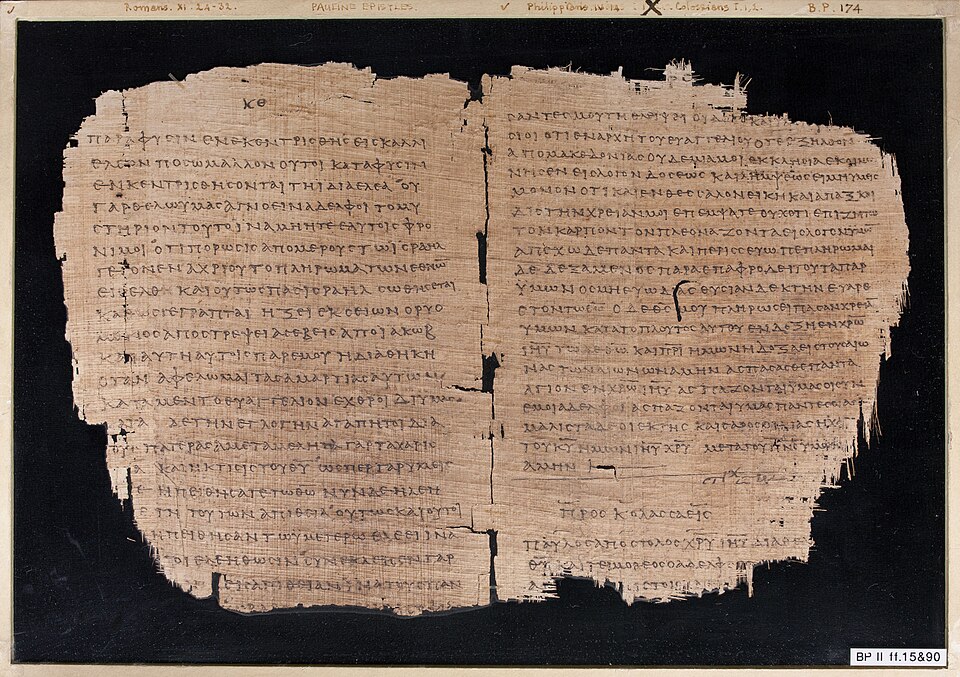
No surviving manuscript of Galatians omits the words. Nor does the phrase interrupt the argument. Paul is establishing that his commission did not come from Jerusalem while accounting for the Jerusalem leaders he actually met. Naming Cephas and James is exactly what the passage requires.
Interpolation remains possible in the thin sense that almost any short ancient sentence could have been inserted before our manuscripts. Historical judgment needs positive evidence: a textual variant, a broken argument, alien vocabulary or a motive that explains both insertion and early universal acceptance. Here there is no manuscript trail, the syntax works, the vocabulary is Pauline, and 1 Corinthians 9:5 supplies an independent Pauline parallel.
Josephus closes the triangle
Josephus reports that the high priest Ananus executed "the brother of Jesus who was called Christ, James by name" in 62 CE (Antiquities 20.200).[2] This is not the disputed Testimonium in book 18. It is a brief identification inside a story about Ananus, and the overwhelming majority of specialists accept it as authentic.
Paul and Josephus write for different audiences and have different reasons to mention James. Paul identifies a Jerusalem leader he met; Josephus identifies a man whose execution helped cost a high priest his office. Both identify James through Jesus. Their wording is not identical and need not derive from one another. Together they make the family reading much less ad hoc than a lost cultic title found nowhere outside the theory built to remove it.
What follows, and what does not
The evidence does not establish the virgin birth, resurrection or any miracle. It does not tell us whether "brother" meant full brother, half-brother or stepbrother, questions on which later Christian traditions divide.[4] It establishes something much smaller: Paul understood James as belonging to Jesus's family, and Josephus knew the same identification.
For historicity, small is enough. A celestial figure can acquire symbolic siblings in later myth. A recently executed man's brother, alive in Jerusalem and personally encountered by Paul, is a different kind of evidence.
Sources and further reading
- Galatians 1:18–20; 1 Corinthians 9:5. ↩ ↩2
- Josephus, Antiquities 20.197–203. ↩
- Chrissy M. Hansen, "Familial Brother(s) of the Lord? On Recent Disagreements on Galatians 1.19 and 1 Corinthians 9.5", Expository Times 136/11 (2025), 483–493. ↩ ↩2
- John P. Meier, "The Brothers and Sisters of Jesus in Ecumenical Perspective," Catholic Biblical Quarterly 54/1 (1992), 1–28. ↩
- Daniel N. Gullotta, "On Richard Carrier's Doubts", Journal for the Study of the Historical Jesus 15 (2017), 310–346.
Figures
- Fig. 1 · Papyrus 46 (Chester Beatty, c. 200 CE), the oldest surviving collection of Paul’s letters: a bifolio spanning Romans, Philippians and Colossians. Wikimedia Commons