P52
Redating P52 does not date John’s composition, still less establish that Jesus was invented.
Responding to mythicism.web.app/p52
Claim headings and boxes summarise the source; consult the linked page for its original wording.
The response
Redating P52 does not date John’s composition, still less establish that Jesus was invented.
The fragment’s uncertain date limits an argument from manuscript survival. It supplies no positive demonstration of CBJ’s second-century reconstruction.
P52 is a small fragment of the Gospel of John held by the John Rylands Library in Manchester. Its importance is real, but limited: it preserves part of a written passion narrative. Dating that copy is a different question from dating the Gospel's composition or establishing the events it describes.
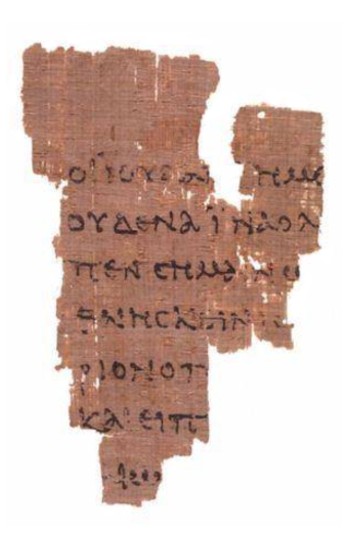
"The date has been updated to closer to 200 CE"
Source claim (summary): the first editor dated P52 to 100–150 CE; the John Rylands Library now describes a date closer to 200 CE.
The Rylands collection record points to a date nearer 200 CE. That changes the manuscript estimate, not the date of the narrated events. The mythicist conclusion does not follow from the catalogue description.
The qualification concerns precision. This is a palaeographical estimate, based on handwriting comparisons, rather than a dated inscription or a securely dated archaeological context. A date near 200 is not a demonstrated year of production. Nor should the older popular date of 125 be treated as a fixed fact.
Brent Nongbri's 2005 study challenges overly precise uses of this fragment to date John. Its bibliographical details and abstract are available from Cambridge University Press. The important methodological distinction is between a proposed range for a surviving copy and a secure boundary for the composition of an entire work.
What follows from a copy's date?
A text must exist by the time its surviving copy is made. But the fragment does not tell us how many earlier copies intervened, how quickly the work travelled, or where its initial composition occurred. There is no demonstrated minimum of several generations between composition and an Egyptian copy.
For example, a copy made around 200 would be compatible with composition around 150. That compatibility does not establish a 150 date; it means P52 alone cannot exclude it. Dating John requires a wider argument from literary relationships, reception and the manuscript evidence, with the uncertainties in each made explicit. See the Gospels.
Other early papyri do not remove the need for caution. P75's traditional early dating has also been challenged: Nongbri's 2016 study argues that a fourth-century placement deserves consideration. On 16 September 2026 he announced a further article using papyrus-sheet dimensions as dating evidence. That announcement is the source for this update; we have not reviewed the full new article. It would be premature to present either the traditional or proposed later date as settled.
Does P52 establish that Jesus existed?
Not directly. It establishes the existence of the wording it preserves by the date of the copy. A manuscript can transmit accurate history, invention, or a mixture of both; its survival does not decide which.
The historical case therefore needs to be argued from the contents, dates and relationships of the sources, rather than from the age of this artefact alone. The case for a historical Jesus starts with Paul's letters and explains how later evidence contributes.
Sources
- John Rylands Library, Greek P 457: collection description checked directly.
- Brent Nongbri, “The Use and Abuse of P52: Papyrological Pitfalls in the Dating of the Fourth Gospel”, Harvard Theological Review 98/1 (2005), 23–48: publisher metadata and abstract checked.
- Brent Nongbri, “Reconsidering the Place of Papyrus Bodmer XIV–XV (P75) in the Textual Criticism of the New Testament”, Journal of Biblical Literature 135/2 (2016), 405–437: author-hosted paper, including its stated dating argument.
- Nongbri's September 2026 announcement: author report of new research, not an independent verification of its conclusion.
Figures
- Fig. 1 · P52, recto: part of John 18. John Rylands Library, Manchester. Wikimedia Commons