Celsus
The page's own quotations make the counter-case: Christianity's fiercest early critic, with access to Jewish counter-tradition, attacked Jesus's parentage, poverty and sorcery – claims that only make sense about a man he never doubted existed.
Responding to mythicism.web.app/celsus
Around 175–180, the Platonist Celsus wrote The True Word (Alēthēs Logos), the first full-scale intellectual attack on Christianity. The book is lost, but Origen's rebuttal seventy years later quotes it so extensively – roughly seventy per cent by common estimate – that Celsus's argument survives in his own words. The page quotes two of those passages and draws no conclusion. The conclusion is worth drawing.
"Celsus said Jesus was a soldier's son who did miracles by sorcery"
Mythicist claim: Celsus had a very unflattering view of Christianity. He was not a contemporary. He said Jews claim Jesus was the son of a Roman soldier named Panthera, that his mother was turned out by the carpenter for adultery, and that his miracles were sorcery — "the acts of wicked men."
All accurately reported. Now inventory what Celsus's polemic presupposes, using only material the page quotes or Origen preserves alongside it:
- Jesus's mother was a poor spinner in a Judaean village; the "virgin birth" covers an adultery with a soldier, Panthera (1.28, 1.32);
- Jesus worked for hire in Egypt, learned magic there, and returned puffed up, proclaiming himself god (1.28, 1.38);
- he gathered "ten or eleven" disreputable followers – "tax-collectors and sailors of the worst character" (1.62, 2.46);
- he performed wonders, which were sorcery, the same in kind as any market-place magician's (1.68, and the page's 2.49 quotation);
- he was betrayed by his own disciples, condemned, and crucified, taunting details included – the vinegar and gall, the failure to save himself (2.9–37, 2.55);
- his followers then claimed he rose, on the word of "a hysterical female" (2.55).
Every count of this indictment is an allegation about a human being's biography – parentage, employment, travel, associates, execution. Celsus wrote with research: he deploys a Jewish informant-figure (his "Jew" of books 1–2) transmitting the hostile counter-tradition that Judaism actually developed – the Panthera story resurfaces in the Talmud's Ben Pandera material, which is why scholars treat Celsus as our earliest datable witness to that polemical stream. He knew the Christian scriptures well enough to quote them against their owners ("as ye yourselves have recorded," in the page's own excerpt). In other words: the second century's best-informed, most motivated opponent, with independent Jewish sources at hand, audited the Christian story – and the audit's verdict was illegitimate son, hired hand, sorcerer, justly executed. The one charge never laid, by him or by the Jewish tradition he tapped: there was no such man.
That silence is not an accident of taste. Celsus's whole strategy is to concede the events and degrade their interpretation – sorcery not divinity, bastardy not virgin birth, corpse not resurrection. It is the strategy you adopt when the events themselves are beyond contesting, two or three generations after the fact, with hostile communities (Jewish and pagan) holding their own memory of the affair. Where Celsus did think a cult figure was fictitious he said so – he ridicules Christians in the same work for worshipping alongside cults of invented and deified nobodies (Antinous of recent memory). The tool was in his hand. He never applied it to Jesus.
The page's one evaluative note – "he was not a contemporary and was born long after Jesus" – is true. It also applies to nearly every source for nearly every ancient figure; Celsus stands closer to Jesus than our principal sources stand to Alexander. His value lies not in proximity but in independence and hostility. Corroboration from an enemy's research is about as strong as ancient history gets.
The 2.49 passage – what the sorcery argument actually shows
Mythicist claim: "Jesus himself does not deny that these works at least are not at all divine, but are the acts of wicked men… he has himself acknowledged that these are not the works of a divine nature, but the inventions of certain deceivers."
The page quotes this at length, apparently as an ancient authority against the miracles. Fine – this site defends no miracle; see the editorial line on the home page. But watch Celsus's move, because it is instructive about the entire ancient debate. He takes Jesus's own recorded warning – false prophets will come working signs (Matthew 24:24 territory) – and turns it: if wonder-working proves nothing when they do it, it proves nothing when he does it. It is a clever argument, and its premise is that Jesus said things and did things that impressed crowds – Celsus nowhere disputes the deeds; he reclassifies them. Sorcery was the standard ancient counter-explanation for a rival's wonders (the Gospels themselves preserve the charge in real time: "he casts out demons by Beelzebul," Mark 3:22 – the accusation is older than the Gospels' final form, since they are stuck answering it). A tradition inventing a founder from nothing does not also invent, preserve and struggle against a hostile explanation of his deeds. The Beelzebul charge inside the Gospels and the sorcery charge in Celsus and the Talmud are three sightings of the same fact from three camps: contemporaries and near-contemporaries agreed something happened around this man, and fought over the explanation. Fights over the explanation of a career are evidence of the career.
Full bibliography
- Origen, Contra Celsum, trans. Henry Chadwick (Cambridge: CUP, 1953).
- Peter Schäfer, Jesus in the Talmud (Princeton: PUP, 2007).
- Robert E. Van Voorst, Jesus Outside the New Testament (Grand Rapids: Eerdmans, 2000).
- Morton Smith, Jesus the Magician (New York: Harper & Row, 1978).
- Graham Stanton, Jesus and Gospel (Cambridge: CUP, 2004).
Figures
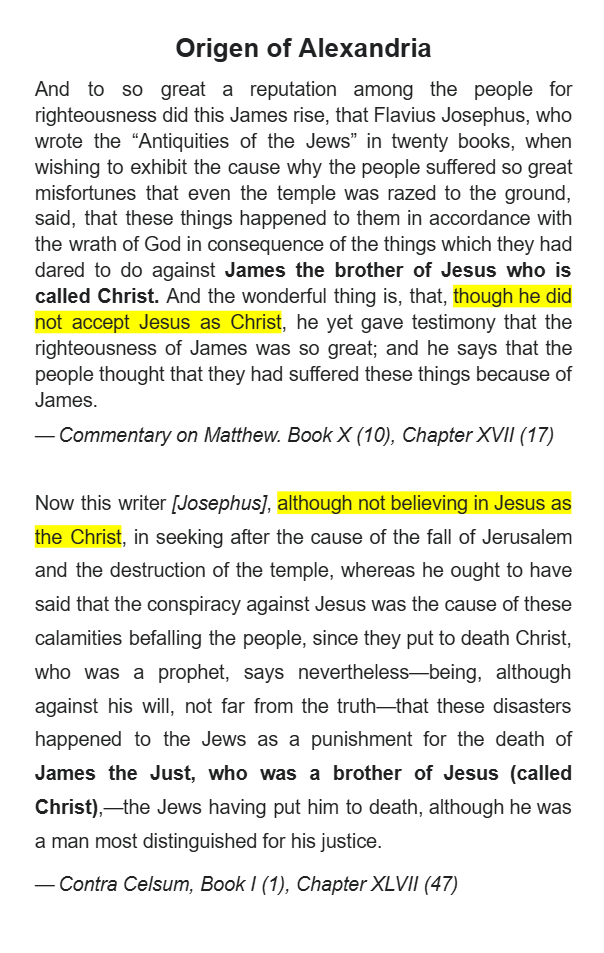
- Fig. 1 · Origen of Alexandria, through whose Contra Celsum the whole of Celsus survives. Image as used on the source site. mythicism.web.app