Are Paul’s Letters Earlier Than the Gospels?
The undisputed Pauline letters are normally dated to the 50s CE, before the surviving narrative Gospels. Their internal chronology and reception make wholesale second-century dating implausible.
5 sections4 citations1 figure
The short answer: yes. Critical scholarship normally dates the seven undisputed letters of Paul to roughly 50–60 CE, while Mark is commonly placed around 65–75 and the other canonical Gospels later. Manuscripts do not preserve Paul’s originals, but dating rests on historical context, interlocking letters and reception as well as surviving papyri.
Which letters are undisputed?
Romans, 1–2 Corinthians, Galatians, Philippians, 1 Thessalonians and Philemon form the widely accepted core.[1] Disputes over Ephesians, Colossians, 2 Thessalonians and the Pastorals should not be transferred automatically to that core.
How are the letters dated?
Acts places Paul before Gallio; Paul's letters refer to Achaia, Macedonia, the Jerusalem collection and named associates. These sources can be compared without assuming Acts is always right. The letters also preserve developing disputes rather than a single retrospective biography.
501 Thessalonians and early Pauline missionsecure range
50–60Undisputed Pauline correspondencesecure range
65–75Mark’s Gospel, common scholarly rangedebated
80–100Matthew, Luke and John, broad conventional rangesdebated
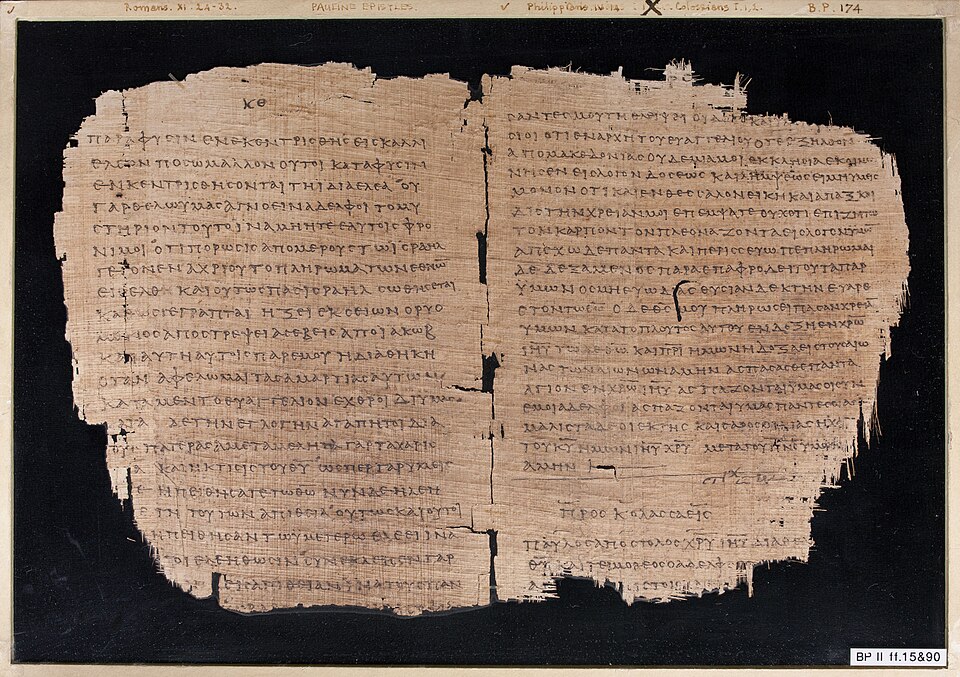
ca. 200P46, early substantial Pauline manuscriptmanuscript
Does the date of P46 make the letters late?
No. A manuscript’s copying date is not its composition date.[3] P46 proves circulation by around 200, while earlier authors and collections push reception backwards. The same distinction is routine for classical literature, where surviving copies can be centuries later than composition.
Could Marcion have created Paul?
Marcion’s mid-second-century collection shows that he valued and edited Pauline letters.[4] It does not show that he wrote them. Earlier reception, including 1 Clement and likely Ignatius and Polycarp, makes a sudden Marcionite creation difficult. The letters’ Jewish scriptural argument and internal conflicts also resist reduction to one second-century programme.
Why does this matter for historicity?
Paul is earlier than the narrative Gospels and knows a movement before himself, Jerusalem leaders, Jesus’s brother, teachings attributed to the Lord, crucifixion and burial traditions. His evidence is limited and occasional, but it prevents the sources from beginning only with late biographies.
See What Did Paul Know About Jesus? and Was Christianity Invented in the Second Century?.
Sources and further reading
- Magnus Zetterholm, “Pauline Letters”, Oxford Bibliographies. ↩
- James D. G. Dunn, Jesus, Paul, and the Gospels (Eerdmans, 2011).
- Bruce M. Metzger and Bart D. Ehrman, The Text of the New Testament, 4th ed. (Oxford University Press, 2005). ↩
- Jason BeDuhn, The First New Testament (Polebridge, 2013). ↩
Figures
- Fig. 1 · Papyrus 46 (Chester Beatty, c. 200 CE), the oldest surviving collection of Paul’s letters: a bifolio spanning Romans, Philippians and Colossians. Wikimedia Commons