Anachronisms
Real anachronisms in the Gospels date the *writing*, not the man – that's how scholars established the 70–100 CE datings in the first place. And several of the page's examples (rabbi, Bethesda, divorce) are contradicted by the primary evidence.
Responding to mythicism.web.app/anachronisms
An anachronism in a narrative tells you when the narrative was written, not whether its subject existed. A biography of Washington that has him vaping dates the biography; it does not delete Washington. Critical scholarship's dating of Mark to c. 70 rests on exactly this logic – Mark 13's temple fixation is the discipline's own dated fingerprint. So the page's stronger examples, where they hold, converge on the mainstream position: Gospels written 70–100, a generation-plus after the events, shaped by their own present. That was already the consensus. The question is whether any example pushes the tradition itself out of the first century – and the flagship examples don't survive their own sources.
"'Rabbi' didn't exist as a title before 70 CE"
Mythicist claim: Yohanan ben Zakkai was the first to receive the title of Rabbi, after 70 CE. John and Matthew use "Rabbi" of Jesus; Matthew 23 wrongly has Pharisees and Rabbi co-existing before 70. Contemporary sages — Hillel, Shammai — were quoted without the prefix. Josephus never uses the term.
The underlying scholarship is real: the formalised title "Rabbi" – an ordained office with the honorific prefixed to a name – is a post-70, rabbinic-movement institution, and the sages of the pairs (Hillel, Shammai) carry no title in the Mishnah. So far, so good; this is a standard observation (Shaye Cohen and Catherine Hezser are the scholarly anchors).
But the Gospel usage is not the formal title – and the page's own proof-texts show it. In every listed verse, rhabbi is a vocative form of address: "Rabbi, where are you staying?"; "Rabbi, we know you are a teacher from God." It transliterates Aramaic rabbî – literally "my great one," from rab, "great/master" – a live Semitic honorific long before it hardened into an office. Mark glosses it as such, and John 1:38 translates it for the reader: "Rabbi (which means Teacher)." That gloss is the tell: the evangelists know it as a spoken Aramaic address needing translation for Greek audiences, not as an institutional title – precisely the pre-70 usage. Epigraphy agrees: rab- honorifics appear across Second Temple-period Semitic inscriptions, and Matthew 23:7–8 – the page's "incorrect" chapter – actually depicts the term as an emerging fashion the scribes love being called and Jesus's followers must avoid, which is polemic against a contemporary trend, exactly what a late-first-century author embedded in the title's formalisation would write. In other words: the verse the page cites as the anachronism is the verse scholars cite to date Matthew – the accepted conclusion, again.
Josephus's silence fits the same picture: writing in Greek for Romans, he calls teachers sophistai and didaskaloi – as does John when not quoting direct address. Vocabulary tracks audience.
"Round tomb stones, linen burial and denarii are all out of period"
Mythicist claim: Kloner's "Did a Rolling Stone Close Jesus' Tomb?" found only four round-stone tombs from the Second Temple period, all with known owners; small round stones are Byzantine. Simple-linen burial wasn't standard until Gamaliel II (c. 118). Ariel's coin survey finds significant denarii in Jerusalem only after 69 CE; the Tyrian shekel dominated in the 30s.
Take them in turn, because they are of very different quality.
The rolling stone: the page's source argues the opposite of the page. Amos Kloner's article is not a debunking of the tomb narratives – it is a close reading defending their plausibility in period terms. His point: round disk stones were rare (he catalogues the few, all elite tombs), square blocking stones were the norm, and the Gospel verbs (kulio, "roll/move") fit a blocked tomb of either type; Matthew's developing "rolled away" imagery may reflect later assumptions. Conclusion drawn by the author himself: the burial story matches Second Temple practice – rock-cut tomb, blocking stone, linen wrapping – with at most a linguistic upgrade in the retelling. Citing the article's rarity statistic while omitting its thesis is the page's least careful move, and it is checkable: the article is exactly where they say it is.
Linen: the Gamaliel II tradition is about ostentation, not fabric. The rabbinic notice (the page's own Jewish Encyclopedia link says so) is that Gamaliel ordered simple linen to end ruinously expensive funeral garments – reforming extravagance, not introducing cloth. Shrouds (takrikhim) in linen were the existing practice being simplified; the Gospels' λέντιον/σινδών wrapping is generic Judaean burial, and archaeology has recovered first-century shrouded burials (the Akeldama "shrouded man" the page itself cites – explaining away one confirmed counterexample with disease speculation concedes the type exists). The single-sheet Shroud-of-Turin point is right – see Shroud of Turin, where this site agrees the relic is medieval – but the Gospels don't describe the Turin cloth; John describes strips and a separate face-cloth.
Denarii: the strongest of the three, and it dates the writing. Ariel's survey is good numismatics; Tyrian shekels and Prutot dominate pre-70 Jerusalem finds, and the tribute-penny scene reads most naturally as Mark staging a Roman-tax debate in the coinage his own audience knew. Fine – that is Mark composing c. 70 for a Roman-ruled readership, which is when and where everyone says he wrote. (Two footnotes: coin finds undercount silver, which was hoarded and removed, not dropped; and the denarius was the standard unit Roman tribute was reckoned in empire-wide, so the scene's premise is not impossible even in the 30s. But grant the point wholesale and it dates a pericope's framing, nothing more.)
"The Pool of Bethesda was Hadrian's Asclepion — John describes something that didn't exist"
Mythicist claim: Healing pools were Greco-Roman, distinct from mikva'ot. John 5 uses the present tense, suggesting the pools exist at the time of writing — but Rome razed Jerusalem in 70, and Hadrian built the grand Asclepion with five porticos after 129. So John describes a site that didn't exist in Jesus's day, with the wrong function, surviving only because it was built later.
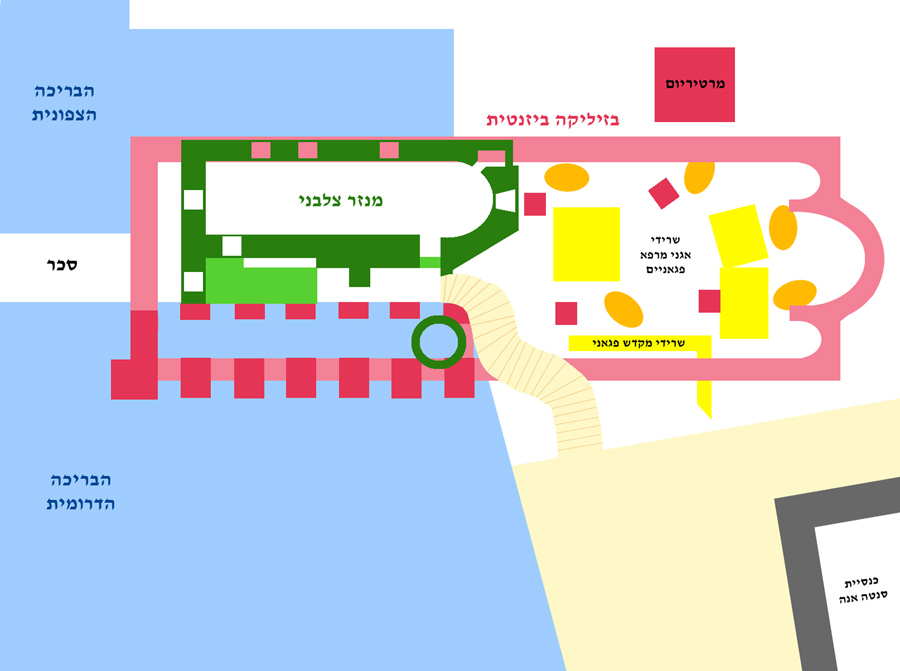
This has the argument exactly inverted, and the excavation reports are the referee. The Bethesda site (St. Anne's, Jerusalem) is stratified: the twin pools with their surrounding porticoes are Second Temple-period construction – the southern pool most likely Hasmonean-to-Herodian, serving the Temple's water needs, with the "five porticos" matching the twin-basin layout (four sides plus the central partition – the detail John gets right that no second-century visitor to Hadrian's remodelled shrine would reconstruct). The Asclepieion is a later layer built into the eastern part of the complex – small grottoes and votive baths from Aelia Capitolina. Hadrian did not create the pools; he re-purposed an existing Jewish water installation, as urban conquerors do.
So John 5 describes a real pre-70 Jerusalem installation with an accurate architectural quirk – which is why this passage runs in the opposite direction in the scholarly literature: since Jeremias, Bethesda (with the Siloam pool, excavated 2004, another Johannine location confirmed) is cited as evidence that John's gospel, whatever its date and theology, carries accurate pre-destruction Jerusalem topography that a late author without local tradition should not possess. Von Wahlde's survey of the archaeology makes exactly this case. The present-tense verb in John 5:2 ("there is in Jerusalem a pool…") is the one piece the page reads rightly – and its standard scholarly uses are either evidence for an early stratum of the tradition or a historic present; nobody who has read the stratigraphy uses it to make the pools Hadrianic.
And on "healing pools were Greco-Roman, not Jewish": the page should meet John 9, where Siloam – a mikveh-fed pool – is a healing site, and the popular belief John 5 describes (waters stirring, first-in healed) is folk religion, which respects no tidy taxonomy of cult. People with sick bodies gather at famous waters in every culture; Judaea was not exempt.
"Mark 10:12 — women couldn't initiate divorce; and the torn veil copies Titus"
Mythicist claim: Women initiating divorce wasn't an option in that period. The temple veil ripping echoes Titus, who bragged of slashing the curtain in 70 and paraded it in Rome; the Arch of Titus shows the sack.
Divorce: the blanket claim is false at the top of the society Mark's readers knew. Herodias divorced Herod II to marry Antipas – Josephus reports it with disapproval as a breach of ancestral law (Ant. 18.136), which proves both that it happened and that it was scandalous; Salome I had earlier sent Costobarus a bill of divorce (Ant. 15.259). Papyri from the Judaean desert (P. Se'elim 13, the much-debated "divorce document of Shelamzion") keep the question live even below the elite. The standard critical reading of Mark 10:12 is either that Jesus's saying glances at the Herodian scandal – the very affair that killed John the Baptist – or that Mark extends the logion for his Roman audience, where wives initiating divorce was routine. Both options are first-century; neither needs an invented Jesus.
The veil: the Titus anecdote the page relates (sword-slashing, bragging, the veil in the triumph) is not in Josephus or the Arch reliefs – it descends from later rabbinic legend (the Talmud's Titus narratives, which also give him a gnat in the brain), and the Arch shows the menorah and table, not a curtain. What's true is simpler: Mark writes after 70, and the torn veil (Mark 15:38) is his theological verdict on the Temple – most commentators read it exactly so. Symbol composed c. 70, in a document dated c. 70. The anachronism-hunt has once again caught the consensus dating of the book and nothing else.
"Hermas of Romans 16 wrote the Shepherd under Pius I — so Romans is second-century"
Mythicist claim: The Muratorian fragment, Liberian catalogue and pseudo-Tertullian identify Hermas — author of the Shepherd, brother of Pope Pius I (d. 154) — with the Hermas greeted in Romans 16:14. Either there was a huge age gap, or Romans was written in the second century.
Look at the direction of inference. Romans 16 greets a Hermas among two dozen Roman Christians c. 57. A century later, a famous Roman Christian book circulates under the name Hermas – one of the most common slave-and-freedman names in Rome (like Hermes, from which it derives). Late traditions, doing what late traditions do, glue the famous book to the apostolic name: the Muratorian fragment actually argues the reverse of the identification – it insists the Shepherd was written "quite recently, in our times… while his brother Pius sat in the chair," precisely to disqualify it from the canon as non-apostolic. The page's own sources, read together, are a second-century argument against confusing the two Hermases. The scholarly position is unanimous and boring: two different men with a very common name, one of several such onomastic gluings (the church also merged Philip the apostle with Philip the evangelist, and John the apostle with John the Elder – see Papias). Nothing about Romans's date – anchored by Gallio-era chronology and the undisputed-corpus evidence (see Paul) – moves an inch.
Full bibliography
- Shaye J. D. Cohen, "Epigraphical Rabbis," JQR 72 (1981), 1–17.
- Catherine Hezser, The Social Structure of the Rabbinic Movement in Roman Palestine (Tübingen: Mohr Siebeck, 1997).
- Amos Kloner, "Did a Rolling Stone Close Jesus' Tomb?," BAR 25/5 (1999), 22–29, 76.
- Jodi Magness, Stone and Dung, Oil and Spit (Grand Rapids: Eerdmans, 2011).
- Donald T. Ariel, "A Survey of Coin Finds in Jerusalem," Liber Annuus 32 (1982), 273–326.
- Urban C. von Wahlde, "Archaeology and John's Gospel," in J. H. Charlesworth (ed.), Jesus and Archaeology (Grand Rapids: Eerdmans, 2006).
- Joachim Jeremias, The Rediscovery of Bethesda (Louisville: 1966).
- Josephus, Antiquities 15.259; 18.136.
- Tal Ilan, "A Newly Published Divorce Bill from the Judaean Desert," HTR 89 (1996), 195–202.
- Carolyn Osiek, Shepherd of Hermas (Minneapolis: Fortress, 1999).
- Raymond E. Brown, The Death of the Messiah, 2 vols. (New York: Doubleday, 1994).
Figures
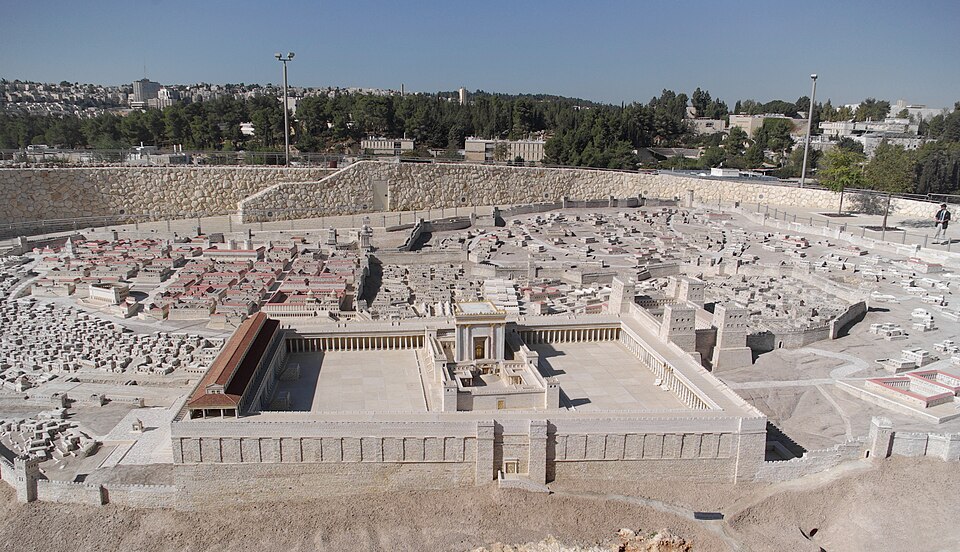
- Fig. 1 · Model of Herod’s Temple in first-century Jerusalem (Holyland Model, Israel Museum). Wikimedia Commons
- Fig. 2 · Plan of the Bethesda complex by St Anne’s, Jerusalem: the Second Temple-period twin pools, with the later Asclepieion grottoes built into the east of the site. Wikimedia Commons