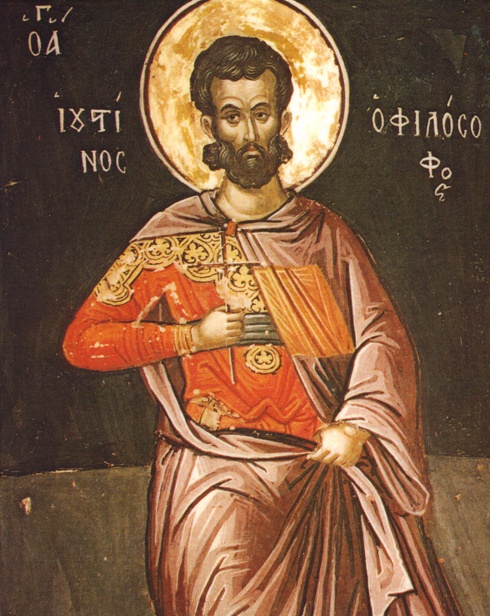
Justin Martyr
Trypho's "if he has indeed been born" is a Jewish argument about the messiah's anointing, not a denial that Jesus lived – the same speech assumes a crucified man. And a Christian source is a strange place for this site to go looking for testimony it trusts.
Responding to mythicism.web.app/justin-martyr
Justin, a Samaria-born philosopher-convert executed in Rome around 165, left two apologies and the Dialogue with Trypho. The page draws exactly one argument from him – Trypho's "if he has indeed been born" – plus two incidental observations. All three are addressable in short order.
"Trypho questioned whether Christ existed — an early example of doubt"
Mythicist claim: Trypho: "But Christ — if He has indeed been born, and exists anywhere — is unknown, and does not even know Himself, and has no power until Elias come to anoint Him… And you, having accepted a groundless report, invent a Christ for yourselves." Regardless of whether Trypho was real, this is an early example of people questioning the existence of, or recognizing the lack of evidence for, a Christ figure.
Read the sentence's grammar and its theology together, because both point the same way.
"Christ" here is a title with a job description, not the man Jesus. Trypho's speech is a compact statement of one strand of second-century Jewish messianism: the messiah (Christos, the anointed one) may already have been born and be living somewhere unrecognised – not even knowing himself – powerless until Elijah comes to anoint and reveal him. That "hidden messiah" doctrine is independently attested in rabbinic tradition (the messiah sitting unrecognised among the lepers at Rome's gate, b. Sanhedrin 98a; the Elijah-as-anointer expectation built from Malachi 3–4). Trypho is saying: the anointed one, whoever he turns out to be, has not yet been revealed – so your man cannot have been him. The conditional "if he has indeed been born" governs the messiah of Jewish expectation, not the Galilean; it entertains that God's anointed may or may not yet exist. "You invent a Christ for yourselves" then means exactly what it says: you have wrongly conferred the title on your Jesus – invented a Christ, not invented a Jesus.
That this is the right reading is settled by the rest of the same dialogue, where Trypho argues on the assumption that Jesus lived and died: the scandal he presses hardest is that "this so-called Christ of yours… was crucified" and thereby fell under the Law's curse (ch. 32; cf. 89–90: "that he was to suffer we admit — but crucified? cursed is he that hangeth on a tree"); he demands proof that this man fits the prophecies, disputes the virgin-birth exegesis (ch. 67: born a man of men, and chosen), and suggests Jesus's followers mistook him for the messiah. None of those arguments is available to someone claiming Jesus never existed; all of them are arguments that a real, crucified man fails the messianic job description. Second-century Judaism's polemic, here and everywhere else it surfaces (Celsus's Jew, the later Toledot traditions), attacks Jesus's legitimacy, parentage, miracles and death – never his existence. Opponents on the ground, a century closer than we are, with every motive to use the killshot if it existed, never used it.
And note the source's status. Trypho is a literary character in a Christian apology – possibly modelled on a real debate, possibly not – voicing the objections Justin wants to answer. The site elsewhere discounts Christian testimony wholesale; it cannot consistently promote one Christian-authored speech to the status of independent early scepticism, while discarding the surrounding text in which the same speaker presupposes the crucifixion. Quoted fairly, the Dialogue is evidence of what actual second-century anti-Christian argument looked like – and it looked nothing like mythicism.
"Justin mentions no Popes — only a 'president' of the Eucharist"
Mythicist claim: Justin operated in Rome but never mentions Popes or bishops; he describes a "president" (proestōs) carrying out the Eucharist, suggesting a less centralised structure.
Correct – and it is the consensus of church historians, argued most fully by Lampe: mid-second-century Roman Christianity was a federation of house communities led by presbyters and teachers (Justin himself taught in rented rooms above a bath-house), with the monarchical bishop emerging only late in the century. This site has already used the point against the papal back-projection on the Tacitus and Pliny pages. It is a finding about church government, borrowed from the same critical scholarship that dates the gospels to the first century – and it has no bearing on whether a Galilean was crucified 120 years before Justin wrote.
"Justin noted that the Christians are Chrestians" – no: Justin puns, in Greek, on his accusers' pronunciation: "we are accused of being Christianoi; but to be chrēstianoi (excellent) is not just cause of hatred." It is wordplay on a homophone, made possible precisely because outsiders said the name with an eta – the phenomenon covered in full on the Before Jesus page. A pun is not a concession of identity.
"Justin says the eucharist copies the rites of Mithras"
Mythicist claim: Justin Martyr wrote about the customs of the eucharist. He states that worshippers of Mithras commanded the same thing. He also notes that Christians are "Chrestians," and was the first to equate the apostle John with the author of Revelation, which Eusebius refutes by proposing a different John.
All three reports are accurate, and the first is more interesting than the page makes of it.
On Mithras. In 1 Apology 66 Justin describes the bread and cup, then says that "the wicked devils have imitated" this in the mysteries of Mithras, where bread and a cup of water are set out with certain formulas. He is not conceding borrowing; he is deploying the standard patristic move of diabolical mimicry, in which every pagan parallel is explained as demons counterfeiting Christian rites in advance. That reflex is worth noticing precisely because it shows what an apologist does when confronted with a parallel: he does not deny it, he explains it away. What Justin's remark establishes is that a Christian in the 150s knew of similar-looking Mithraic practice, not that the eucharist was derived from it. Establishing derivation would need Mithraic evidence of the right date, and the surviving Mithraic material is largely second-century and later, which is the direction of dependence the page would need to run the other way.
On "Chrestians." Correct, and it helps the case this site makes elsewhere. Justin plays on chrestos, "useful, good," when defending the name in 1 Apology 4. The outsider spelling with an e was current, which is exactly why Tacitus's manuscript reads chrestianos and why that reading is evidence of a Roman writing what Romans said rather than of a Christian interpolator (Tacitus).
On the two Johns. Also correct, and this site has already granted it. Justin is the first to identify the apostle as the author of Revelation, and Eusebius himself distinguishes a second John, the Elder. That is a point against traditional authorship claims, which this site does not defend (Papias, Gospels).
None of the three bears on whether Jesus existed, and the page does not claim otherwise.
Full bibliography
- Justin Martyr, Dialogue with Trypho; 1 Apology.
- Oskar Skarsaune, The Proof from Prophecy (Leiden: Brill, 1987).
- Peter Schäfer, Jesus in the Talmud (Princeton: PUP, 2007).
- Peter Lampe, From Paul to Valentinus (Minneapolis: Fortress, 2003).
- b. Sanhedrin 98a; Origen, Contra Celsum 1.28–32.
Figures
- Fig. 1 · Justin Martyr by Theophanes the Cretan (16th century), an imagined portrait. Wikimedia Commons