Christ Before Jesus
The book behind the source site, measured against its own thesis. An instrument that cannot produce the conclusion, data that points the other way, a central piece of the argument retracted by its own author, and a reception in which nobody who examined the method endorsed the result – mythicists included.
Responding to christbeforejesus.com/
Christ Before Jesus: Evidence for the Second-Century Origins of Jesus (2024) is the book behind mythicism.web.app – the source of the stylometric charts that recur across the site and its streams. Its thesis is the most radical on offer anywhere in the mythicist world: Jesus never existed, Paul never existed, the entire twenty-seven-book New Testament is a second-century production originating in the circle of Marcion of Sinope, and computational stylometry demonstrates all of it.

- Full title
- Christ Before Jesus: Evidence for the Second-Century Origins of Jesus
- Authors
- Matthew Britt · Jaaron Wingo
- Published
- 5 March 2024, Cooper & Samuels Publishing – reported by Carrier to publish no other title
- Extent
- xii + 317 pp. (per the JECH bibliographic record)
- ISBN-13
- 979-8990235809 – the 979-8 prefix is the self-publishing range
- Formats
- paperback · Kindle
- Publisher's description
- claims "proven, peer-reviewed mathematics" – the method has not passed peer review (see below)
- Thesis
- no Jesus, no Paul; the New Testament a second-century production of Marcion's circle
- Method
stylo(R), Eder's Delta, 100 MFW, chapter-level samples- Peer review
- not passed. Britt stated in August 2024 that the claim covers the software, "not that our specific results have been peer reviewed"
- Journal notice
- Hansen, JECH 14/1 (2024), 70–73 – DOI (review, paywalled, not consulted here)
- Post-publication status
- proto-Mark withdrawn by Britt on the record, 14 August 2024, five months after publication
- Companion sites
- christbeforejesus.com · mythicism.web.app
This page reviews the book against that thesis. Not against Christianity, not against mythicism in general – against the specific claim on its own cover. The authors themselves are profiled separately on Britt & Wingo, and the stylometric method is answered technically on Stylometry; this page is about whether the book's argument, taken on its own terms, gets anywhere near its conclusion. The finding, developed section by section below: the book's chosen instrument cannot produce the conclusion even in principle, the instrument's actual output points the other way, the authors have already retracted one load-bearing result in public, and every reviewer who examined the method – including those who share the book's conclusion – declined to endorse it.
A thesis with nothing under it but one instrument
The book's subtitle and stated aim: Evidence for the Second-Century Origins of Jesus – the claim that stylometric analysis of the Greek New Testament shows the whole corpus, Paul included, to be a second-century fabrication.
State the burden plainly, because the book never does. To prove second-century origins, the argument must do two things at once: positively date the composition of every New Testament text after roughly 140 CE, and negatively dispose of every earlier witness to those texts – 1 Clement quoting 1 Corinthians around 96, Ignatius invoking Paul about 110, Polycarp telling the Philippians that Paul "wrote you letters," Papias on Mark and Matthew, 2 Peter complaining that people twist "all his letters," Justin Martyr quoting the Gospels in the 150s as established community texts.
The book's positive case is stylometry alone. Strip the charts out and what remains is a narrative about Marcion that the second-century sources themselves contradict – Marcion's opponents attack him for editing an existing corpus, not for producing one (Marcion). So the instrument has to carry the entire thesis. Everything below is about whether it can.
The story it must tell instead
The book's reconstruction: the New Testament originates in the second century, in and around the circle of Marcion of Sinope – the Gospels, Acts, and "Paul" alike produced by a workshop whose output was then absorbed, expanded and domesticated by the emerging church.
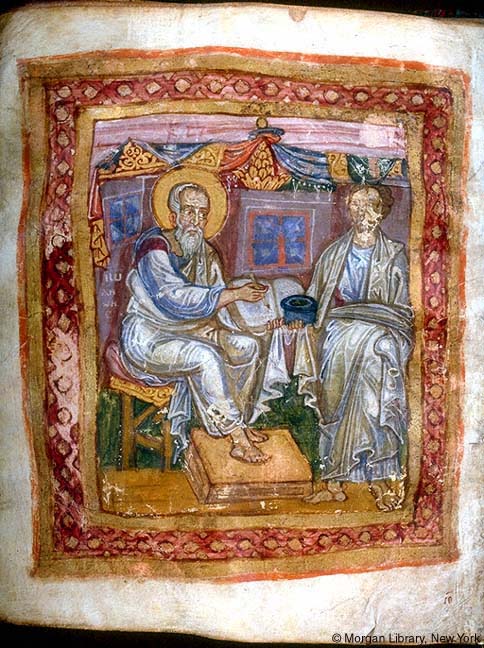
Since the instrument cannot date texts, the thesis in practice rests on this narrative – and the narrative has a problem the book never solves: every second-century witness to Marcion, hostile and otherwise, describes him doing the opposite of what the thesis requires.
Marcion's opponents do not accuse him of inventing scriptures. They accuse him of cutting scriptures they already possessed – "with a penknife," in Tertullian's image. Tertullian's reply runs to five books precisely because Book V can work through Marcion's apostolic collection letter by letter, arguing from the text of epistles both sides already hold in common. Jason BeDuhn's study of the Marcionite canon – the very book Britt and Wingo lean on for their textual claims, and the one their forum critics cite back at them – is titled The First New Testament: Marcion's Scriptural Canon because it treats the Apostolikon as an edition: a curated, redacted publication of an existing corpus, with rival textual traditions on either side of it. An edition is downstream of its sources. The book's thesis needs the river to run uphill.
That inversion has to be defended somewhere, and it never is. The one place the authors were publicly pressed on the ordering – whether any text-analysis basis exists for putting Marcion's gospel before Mark – the request went unanswered (see the retraction section below). The full case on Marcion, including what his canon actually attests, is on the Marcion page; what belongs here is only the structural point: with stylometric dating gone, the book's entire positive account hangs on a sequence its own preferred authority describes the other way round.
The instrument cannot produce the conclusion
M. David Litwa, the book's most sympathetic qualified reviewer: the authors "push stylometry beyond what it was designed to show. Stylometry is excellent for discovering distinct authors of texts, but it is not very good at dating texts."
The friendliest reviewer raises the objection that ends the thesis before any detail is reached. Stylometry compares habits of style between texts; run competently, it can suggest that two texts share or do not share an author. It has no access to when anything was written. A dendrogram showing Colossians clustering apart from Romans says nothing about whether either was written in 55 or 155. There is no calendar in word frequencies.
Dustin White, reviewing from the opposite ideological direction, lands on the identical point: "stylometry isn't used to date texts. That's not what it's used for." When the Christian critic and the mythicism-sympathetic scholar independently name the same category error, the error is not a matter of perspective.
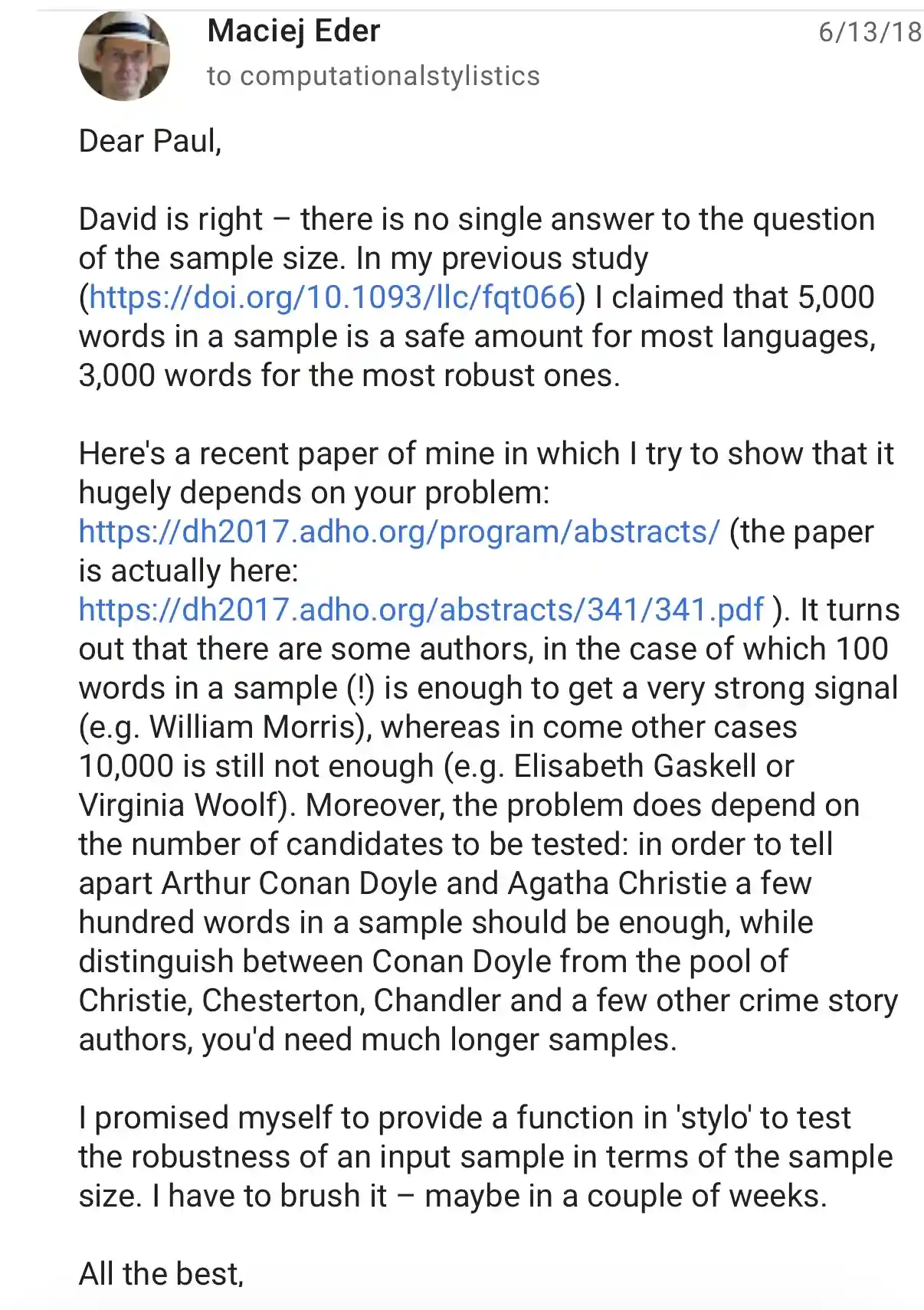
And that is before the execution, which is answered fully on Stylometry and summarised in one sentence here: the analysis runs at chapter-length samples averaging about 372 Greek words against a floor of roughly 2,500 set by the tool's own author, at 100 most-frequent-words against a recommended 1,000–1,500, using default settings the authors described to White as "opening up Stylo, changing just the distance measure, and then running the program," in a language they state they cannot read. The dating claim would be unsupported even if all of that were done right; done like this, the charts do not establish authorship either.

Where the instrument did speak, it said the opposite
Coty Trout, structural review: the authors' own stylometric data "consistently confirms a unified Pauline authorial voice" – the opposite of the book's conclusion.
Take the book's charts at face value for a moment, as its own evidence. Trout's review works through them and finds that the clustering the authors published shows the seven undisputed Pauline letters behaving like the product of one writer – which is the consensus position the book exists to overthrow. The authors read fragmentation into diagrams that, on their face, display coherence.
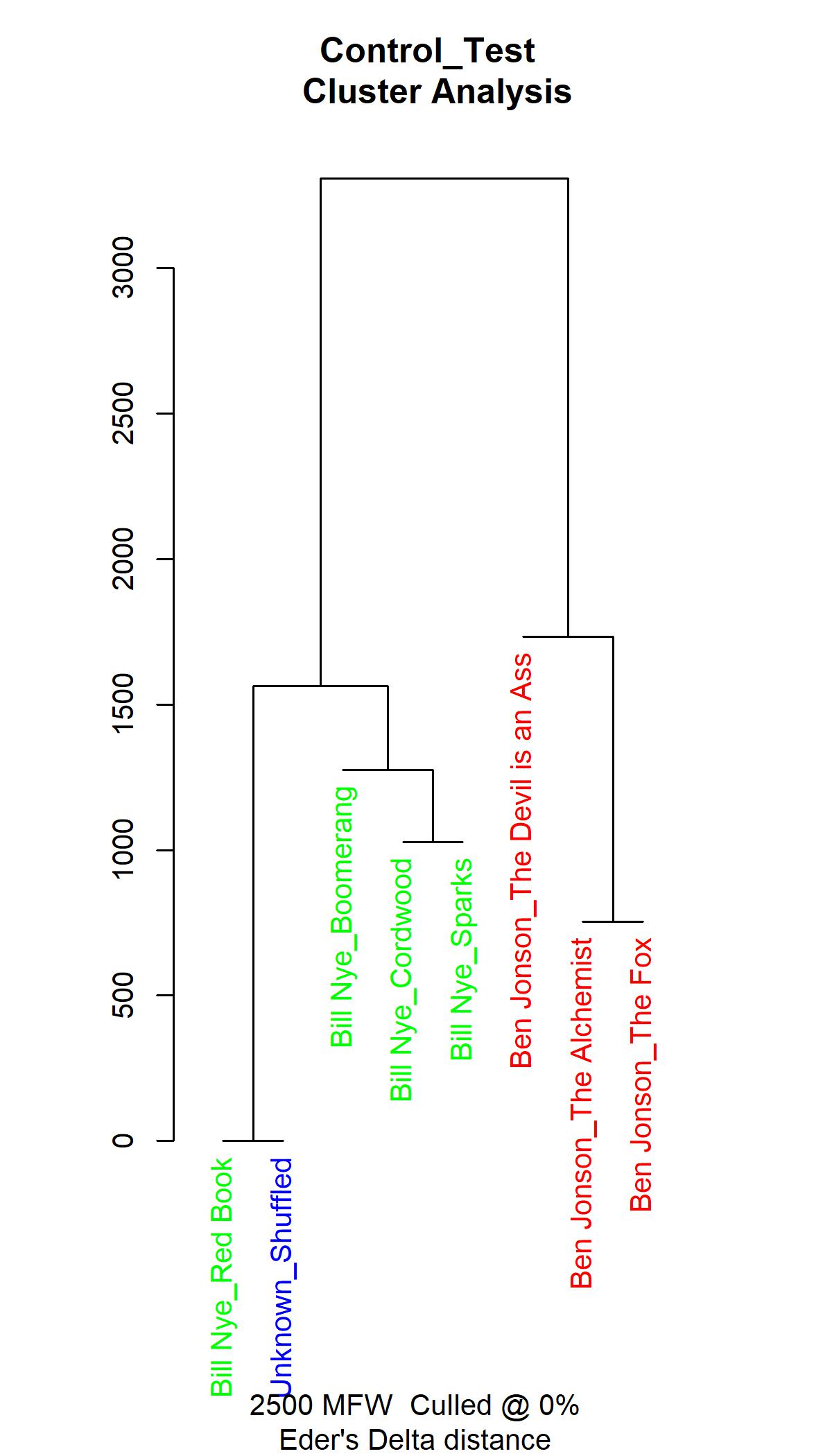
Two further self-inflicted results sharpen the problem. The book's validation run – the tool applied to the authors' own co-written English book – showed a short "Note/Intro" sample clustering "far away from everything else," which the authors correctly attributed to its brevity. Every chapter-length sample in the entire New Testament study is comparably short. They diagnosed the small-sample artefact in their control, then read the same artefact as a discovery everywhere else. And the validation itself tests the wrong thing: distinguishing two living co-authors in modern English says nothing about dating ancient Koine, a point Carrier makes at length.
A study whose instrument cannot yield the conclusion, and whose actual output supports the rival position, has not weakened its target. It has accidentally testified for it.
The retraction
Matthew Britt, Biblical Criticism & History Forum, 14 August 2024: "So something I want to say is that we realized after the book was written that there seems to be no stylometric evidence of proto-Mark. We were working on the assumption of Markan priority, but we are more agnostic on that question now. Yes, we reconstructed what proto-Mark might be, but after extensive testing we found no evidence of anything there… we don't feel comfortable with a proto-Mark anymore."
This deserves more attention than it has received, because it is the book's own author reporting that a piece of the published architecture failed his own subsequent testing – "extensive testing," in his words, that found "no evidence of anything there." It is also early. The book was published on 5 March 2024; the retraction was posted on 14 August, five months later, and volunteered rather than extracted: nobody in the thread had asked about proto-Mark.
Read that both ways. To the authors' credit, it is honest, and honesty about a failed result is rarer than it should be. But consider what it concedes. The book presented its stylometric findings as demonstrated results; the same operators, running the same tool over the same corpus a second time, now report that one of those results dissolves. A method that produces a finding and then unproduces it on re-examination was never measuring what its output was claimed to mean. The retraction does not merely delete one claim from the book – it demonstrates, from inside, the reliability of the process that generated all the others.
The same forum thread records the community's requests for the methodological detail that would let anyone check the remaining claims. No detailed methodological response appears. One member, pressing the authors on the Marcion sequence, notes there is "no direct sign that you can place *Ev prior to Mk on any text analysis basis" – the ordering the entire thesis depends on, unsupported by the book's own class of evidence.
Graphs without numbers, results without inputs
Dustin White: the authors "did 'Photoshop' or edit the graphs," stripping information the tool outputs by default, leaving them "largely useless."
Whatever one concludes about intent – White himself leaves it at manipulation or "sheer ignorance" – the published evidence base of the book consists of cluster diagrams from which the numerical scale has been removed. Carrier, independently: "Their graphs all lack numbers — that's right: there are no 'metrics' in their stylometrics." The source texts are never specified, the tagging is never described, and the only worked example in the book runs on an English translation. Carrier could not determine that the Greek analysis was performed on Greek at all.
The study cannot be replicated in either direction. A sceptic cannot check it; neither can a supporter. Everything rests on trusting operators who state, in the book itself, "We aren't programmers, nor do we have an extensive knowledge of Koine Greek." A result that cannot be checked is not evidence awaiting confirmation. It is a claim wearing the costume of evidence.
The readings, where they can be checked
M. David Litwa, on the book's Septuagintal Revelation argument: "they don't seem to recognize the more obvious explanation: that the author of Revelation was deliberately imitating the language of the Septuagint."
Where the book's claims touch material a reader can verify without software, the pattern repeats in miniature:
- The Parable of the Sower. White documents the book misreading the parable's text in the course of building an argument from it – an error of plain reading, in a book whose thesis is that everyone else has misread the corpus.
- Revelation's archaic Greek. The book treats Revelation's Septuagintal style as evidence about origins; Litwa points out the long-standing and simpler explanation – deliberate imitation of scriptural style – which the book does not engage.
- Irenaeus as the author of Luke–Acts. The book's flagship identification. Litwa: they reach it "mostly because of a fluke," since Irenaeus's Greek does not survive in sufficient quantity to test against. The most headline-grabbing claim in the book is, by its own method's requirements, untestable.
- 1 Clement's date. The book needs Clement late; Litwa's response is that so consequential a re-dating "has to be argued at greater length" than the book gives it. The argument's load-bearing walls are asserted, not built.
- Scribal style. The book waves away scribal influence on ancient texts; White cites the scholarship showing scribes measurably shaped the style of what they copied – a factor that sits directly inside stylometry's margin of error and is nowhere controlled for.
None of these errors requires a rival ideology to see. They require reading the sources the book is about.
What it would take to rescue the thesis
Richard Carrier, mythicist, on the book: "Its authors do not appear to have any relevant credentials. And the book has no academic quality."
Suppose the stylometry were simply deleted from the book, and the thesis defended on the remaining historical argument. What stands in the way is every page of this site's ordinary coverage: the attestation chain for Paul's letters running from Clement through Ignatius, Polycarp and 2 Peter to Marcion's own edition of an existing corpus; the second-century writers who cite the Gospels as established texts; the pagan and Jewish opponents who attack Jesus's followers, his legitimacy and his miracles for a thousand years without once suggesting he did not exist. To hold the thesis, all of it must be re-dated past 140 – every witness, every time, always in the direction the conclusion requires. That is not source criticism; it is a conclusion doing its own sourcing, and it is the same manoeuvre the site's Paul page documents on the letters.
And one structural problem admits no re-dating at all. The six disputed Pauline epistles exist because Paul's name was worth borrowing – pseudepigraphy requires a famous name. A second-century workshop inventing "Paul" from nothing, and simultaneously forging letters in the name of the invention, inverts the only reason pseudepigraphy happens. The theory eats its own precondition.
The field it never joined
Anthony Kenny, Oxford, 1986 – what careful stylometry of this corpus concludes: there is "no reason to reject the hypothesis that twelve of the Pauline epistles are the work of a single, unusually versatile author."
Stylometry of the New Testament is not new territory the book pioneered. It is a small, careful, peer-reviewed literature running back four decades, and its track record shows exactly what the method can and cannot deliver on this corpus.
Kenny – a philosopher and statistician who wrote the standard early study – ran his analysis and delivered the least dramatic conclusion available: the data gave him no reason to reject common authorship for twelve letters. David Mealand's work in New Testament Studies tested the seven-letter hypothesis under explicit statistical controls, worrying at exactly the variables Britt and Wingo never mention: genre, sample size, chronological drift within one author's lifetime. Jacques Savoy's 2019 study – the one Carrier holds up as what passing peer review looks like – ran Burrows's Delta and Labbé's intertextual distance over the Greek, published its methods and distances, and reported modest, checkable clusters: the Pastorals grouping apart, Philemon too short to place. Every one of these studies stops at authorship structure. None claims to date a text, none found a second-century workshop, and none concluded that Paul did not exist.
This is the context in which Christ Before Jesus has to be read. Amateurs are perfectly entitled to do stylometry. Kenny was not a biblical scholar either, and it did not matter because his method could be checked. But when this tool is used on precisely this corpus with published inputs, adequate samples and disclosed numbers, it produces conclusions of a completely different order of magnitude from the book's. It has done so consistently since 1986. A result three revolutions beyond anything the method has supported, produced by the only study in the literature that cannot be replicated, is not the field being overturned. It is a study standing outside the field, reporting what the field's instruments do not show.
The verdict its own side delivered
The tally: the harshest published reviews of Christ Before Jesus come from people who want its conclusion to be true.
| Reviewer | Position | Verdict on the book |
|---|---|---|
| Richard Carrier | Mythicist, PhD ancient history | "No academic quality"; not peer-reviewed; graphs without metrics |
| M. David Litwa | Mythicism-sympathetic scholar | Stylometry "not very good at dating texts"; flagship claim "a fluke" |
| Dustin White (The Curious Christian) | Christian critic | Unreplicable; graphs edited; dating misuse; textual misreadings |
| Coty Trout | Independent reviewer | Data shows a unified Pauline voice; "methodological collapse" |
| Chrissy M. Hansen | Scholar, JECH 14/1 (2024) | Review paywalled, not consulted here; pre-publication: "rather skeptical of their methodology" |
| Nicholas Covington | Mythicism-sympathetic blogger | Favourable: "a refreshing new take"; a 300-word notice, not an examination of the method |
| Matthew Britt | Co-author | Proto-Mark result withdrawn: "no evidence of anything there" |
One qualification, added because the table above would otherwise mislead. The book does have a favourable notice. Nicholas Covington, a committed mythicist who once ran Carrier's argument through Bayes' theorem and concluded that "mythicism is over 99% likely," reviewed it on the Skeptic Ink Network on 18 August 2024. He calls it "a refreshing new take on the origins of the new testament and Christianity" and closes: "Recommended: an important contribution to the study of Christian origins!"
Three things about that notice, none of which disturb the claim being made here. It runs to about three hundred words. It mentions the stylometry exactly once, and treats its output as already established rather than examining it: the gospels are late and Luke derives from Marcion, "which the stylometry tests of CBJ confirms." And Covington explicitly declines the adjudicating role, writing that the book "deserves a proper reading and answer from experts."
He also dissents from one of the load-bearing claims. On the second-century dating of the Pauline letters, which the whole thesis needs, he writes: "I think the Paulines are definitely no later than late first century." So the book's one favourable reviewer recommends it while rejecting the chronology it exists to establish, and refers the method to specialists rather than assessing it.
The claim here is therefore narrower than "everyone hated it": among those who examined the method, nobody endorsed the result.
A book can survive hostile reviews; every consequential book collects them. What Christ Before Jesus has is something else: its most credentialed natural ally leading the prosecution, and one of its own authors contributing the final row. The thesis asked for a revolution in the dating of twenty-seven documents. What the book delivers is a set of unreplicable pictures, produced by a method its friendliest reviewer says cannot date texts, contradicting itself where it can be read, and already shrinking under its own authors' re-testing.
The claims the book injected into mythicism.web.app are nonetheless answered on their merits, page by page, across this site – because that is the standard the book itself declined to meet.
Full bibliography
- Matthew Britt & Jaaron Wingo, Christ Before Jesus: Evidence for the Second-Century Origins of Jesus (Cooper & Samuels, 2024).
- M. David Litwa, "Christ Before Jesus", review, 10 April 2026.
- Richard Carrier, "Statistical Stylometrics: The Good, the Bad, and the Horrid (Part 1: Paul)".
- Richard Carrier, "Statistical Stylometrics (Part 2: Pliny and Galen)".
- Dustin White, "Failing Stylometry"; "A Terrible Methodology"; "Misreading the Parable of the Sower"; "Are they Making it Up", Medium.
- Coty Austin Trout, Christ Before God: A Structural Autopsy of Methodological Collapse in Britt and Wingo's Christ Before Jesus (February 2026).
- Dustin White, "Christ Before Jesus", The Curious Christian, chapter-by-chapter critique.
- Matthew Britt, posts in "The Britt, Wingo response to elaboration requests," Biblical Criticism & History Forum.
- Chrissy M. Hansen, review of Christ Before Jesus, Journal of Early Christian History 14/1 (2024), 70–73, doi:10.1080/2222582X.2024.2366761. Paywalled; cited for bibliographic detail only.
- Maciej Eder, "Does size matter? Authorship attribution, small samples, big problem," DSH 30/2 (2015), 167–182.
- Anthony Kenny, A Stylometric Study of the New Testament (Oxford: Clarendon, 1986).
- David L. Mealand, "Positional Stylometry Reassessed," New Testament Studies 35/2 (1989), 266–286.
- Jacques Savoy, "Authorship of Pauline Epistles Revisited," Journal of the Association for Information Science and Technology 70 (2019).
- Tertullian, Against Marcion, trans. Holmes (ANF III).
- Jason BeDuhn, The First New Testament: Marcion's Scriptural Canon (Salem, OR: Polebridge, 2013).
Figures
- Fig. 1 · The book under review: Christ Before Jesus (Cooper & Samuels, 2024), reproduced for criticism and review. goodreads.com
- Fig. 2 · The apostle John☦ and Marcion of Sinope, Byzantine manuscript, 11th century (Morgan Library MS M.748). The tradition remembered Marcion as an editor of received texts – the book needs him to be their origin. Wikimedia Commons
- Fig. 3 · The tool’s own author on minimum sample sizes – an exhibit the source site itself displays. The book analyses at roughly a seventh of this floor. mythicism.web.app
- Fig. 4 · One of the book’s dendrograms, as exhibited on the source site: a picture of clustering, offered as a calendar. mythicism.web.app
- Fig. 5 · The validation run: the tool distinguishing the book’s two living co-authors in modern English – including the short sample the authors themselves flagged as clustering “far away from everything else.” mythicism.web.app
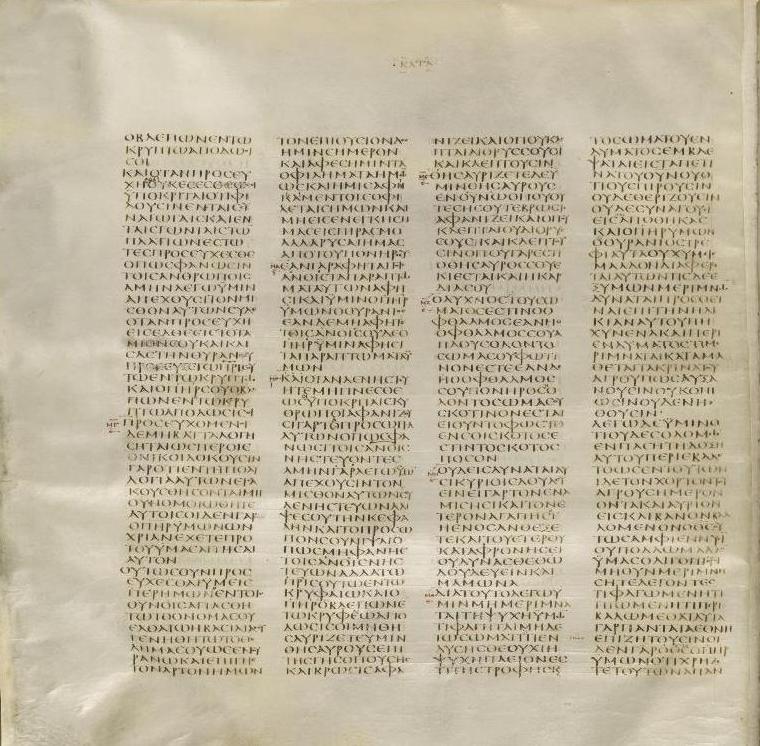
- Fig. 6 · Codex Sinaiticus (4th century), Matthew 6: continuous uncial Greek, no word division, no punctuation. Which digitised text of this the book fed its software is never stated – the first thing every study above discloses. Wikimedia Commons
For external reviews, papers and videos, see our Christ Before Jesus reviews directory, including Coty Austin Trout, Dustin White, Richard Carrier and other reviewers.